What is Dyes? 10 Different Types of Dyes
- Veeraco Colourants
- Oct 09, 2026
Dyes are the chemical pigments that give color to textiles, plastics, inks and more – and they make daily life vibrant and functional. In industry, dyes aren’t just about aesthetics; they ensure products meet quality, safety and performance standards. For example, an acrylic fiber dyed with basic dyes or a cotton fabric dyed with reactive dyes must meet fastness requirements for garments to retain color through washing or sunlight. In other words, dyes are the engineered colorants added to materials, and each class of dye has unique chemistry and uses. Put simply, dyes “work” by bonding to the substrate: they are absorbed onto and into fibers or plastics and then fixed in place. The dye molecules contain chromophore groups that absorb visible light and auxochrome groups that enhance solubility and bonding. In a dye bath, dye molecules migrate from the solution onto the material (a process called exhaustion), and they fix either by ionic attraction, covalent bonding, or physical entrapment. For example, acid dyes attach ionically to protonated amino groups on wool or nylon, whereas disperse dyes simply dissolve into polyester fibers via van der Waals forces. The result is a lasting color: in practice, dye selection and process are critical for ensuring the required wash-fastness, light-fastness and overall quality of the finished product.
What Are Dyes Made Of?
Dye molecules are typically organic compounds with one or more chromophores (light-absorbing structures) and auxochromes (solubilizing/activating groups). Natural dyes come directly from biological sources – plants (e.g. indigo from leaves, madder roots), insects (e.g. cochineal), or minerals – and often feature polyphenolic or quinone structures. Synthetic dyes, by contrast, are man-made chemicals (usually aromatic compounds) derived from coal-tar or petroleum feedstocks. The first synthetic dye (Perkin’s mauveine in 1856) came from aniline (a coal-tar derivative). Today’s synthetic dyes include classes such as azo, anthraquinone, and diazo compounds, tailored for high purity and consistency. Many modern dyes are engineered with metal-complex or proprietary structures for extra fastness. In both natural and synthetic types, functional groups like –SO₃H (sulfonic acid) or –NH₂ (amino) are common, since they improve water solubility or fiber binding. Natural dyes often require a mordant (a metal salt) to fix color on fiber, whereas synthetic dyes incorporate binding chemistry directly into their molecule.
How Do Dyes Work?
In industrial processing, a dyeing operation involves applying dyes to a material (often in water for textiles or solvent for plastics). The process generally follows these steps: the substrate (fiber, plastic, etc.) is prepared (scoured, bleached), then immersed in a dye bath where dye molecules adsorb onto the substrate surface and diffuse in. As dyeing progresses, the bath darkens as dyes attach, and eventually reaches equilibrium (exhaustion) when no more dye moves. At that point, the material is often “set” (by heat, chemical treatment, or pH change) to fix the dye. The specific dye–fiber chemistry determines the mechanism:
- Ionic bonding: Acid dyes (anionic) bond to cationic sites on wool and nylon under acidic pH. Basic dyes (cationic) bond to anionic sites (e.g. wool, silk, acrylic). Direct dyes (anionic) attach to cellulose via hydrogen bonds and Van der Waals forces.
- Covalent bonding: Reactive dyes form true chemical bonds (often ether or secondary amine linkages) with cellulose fibers, yielding very high wash fastness.
- Physical entrapment: Disperse dyes are non-ionic, have low water solubility, and simply diffuse into synthetic fibers (polyester, nylon) at high temperature, where they are held by Van der Waals and hydrophobic forces.
- Reduction–oxidation: Vat and sulfur dyes (both insoluble in their stable form) are chemically reduced to a soluble “leuco” form, allowed to diffuse into fiber, then oxidized back to the insoluble color.
- Precipitation on fiber: Azoic dyes (naphthol dyes) are formed in situ by coupling two soluble components on the fiber, creating an insoluble azo compound fixed in the fiber (commonly used for bright shades on cotton in multi-step processes).
The bonding method governs performance: ionic and Van der Waals attachments give moderate fastness, whereas covalent or insoluble fixation gives superior durability. Dye choice is therefore matched to the material and performance needs.
Classification of Dyes
Dyes can be broadly classified by source (natural vs. synthetic) and by chemical/application class (acid, reactive, etc.).
- Natural vs. Synthetic: Natural dyes are derived from plants, insects or minerals. They tend to be less intense and less consistent, but are renewable and biodegradable. Synthetic dyes are man-made organic chemicals from petroleum or coal-tar feedstocks; they dominate industry due to their vast color range, purity, and performance. The discovery of synthetic dyes in the 19th century revolutionized the dye industry, making colorants mass-producible. Most industrial dyes today are synthetic.
- Application / Chemical Classes: Industry also classifies dyes by how they are applied and their chemistry. The major classes include acid dyes, basic dyes, reactive dyes, direct dyes, disperse dyes, vat dyes, sulfur dyes, mordant dyes, azoic dyes, solvent dyes, and others. Each class has characteristic properties and typical substrates. For example, acid dyes (anionic water-soluble dyes) are used on protein fibers; reactive dyes (with reactive groups) on cellulose; disperse dyes (non-ionic) on polyester; vat dyes (insoluble but reducible) for deep colors on cotton; etc. (Later sections detail these 10 classes.) These classes often overlap with application sectors: for instance, textiles mainly use acid, reactive, direct, disperse, vat and sulfur dyes, whereas plastics and inks use solvent dyes.
Within each class, there are further types (e.g. leveling vs milling acid dyes, metal-complex reactive dyes, etc.) to suit particular needs. In any case, choosing a dye requires considering fiber type, equipment, and required fastness (wash, light, migration, etc.).
10 Different Types of Dyes
Each dye class below represents a key category of industrial dyes. These types cover the most common dyeing applications across industries:
1. Acid Dyes
Water-soluble anionic dyes applied from an acidic bath. They bond strongly to wool, silk and nylon (which become cationic in acid) by ionic interaction. Acid dyes are known for bright, clear shades and good depth of color on protein fibers, as well as good light and wet fastness. They require acidic pH (typically 2–6) and often yield wash and light fastness that meets apparel standards. Veeraco Colourants notes that its acid dyes have “excellent affinity for wool, silk and nylon” and “superior light, wash, and perspiration fastness”. Typical uses include clothing (wool, silk garments), carpets, and leather finishing (wet-blue leather is dyed with acid dyes before processing).
2. Basic Dyes
Also called cationic dyes, basic dyes are water-soluble organic bases that carry a positive charge. They are used on fibers with anionic sites (for example acrylic fibers and some modified nylons) and also on silk and wool under the right conditions. Basic dyes are prized for very intense, brilliant colors (especially on acrylics, where disperse dyes cannot achieve such depth). However, they typically have moderate light-fastness on natural fibers. Besides textiles, basic dyes are used in dyeing jute, paper, and in certain specialty uses (e.g. biological staining). Veeraco supplies basic dyes globally for textiles and paper; its product literature highlights “superior brightness and color intensity” and full water-solubility.
3. Direct Dyes:
Anionic water-soluble dyes that “directly” color cellulose fibers (cotton, viscose) without needing a chemical fixative. Direct dyes adsorb onto the fiber by hydrogen bonding and Van der Waals forces. They are easy and economical to use (short dye cycles, no need for high heat), and are often applied at neutral or mildly alkaline pH. The drawback is that direct dyes have limited wash-fastness and light-fastness, so after-treatments (e.g. cationic fixing agents) are usually required. They’re especially useful for pastel shades on cotton and for applications where bright low-cost color is needed. Industrial cotton apparel (like knitwear) and home textiles may use direct dyes for bulk color, often followed by after-treatment for durability.
4. Reactive Dyes:
These dyes form covalent bonds with the fiber, giving the highest wash-fastness among water-based dyes. Reactive dyes contain chemical groups (e.g. vinyl sulfone, dichlorotriazine) that react with hydroxyl or amino groups on cellulose or protein under alkaline conditions. The result is a permanent bond. Reactive dyes yield vivid, deep shades on cotton, rayon, linen and silk with excellent wash durability. The trade-off is that dyeing requires careful pH control (alkali addition) and handling hydrolysis (reaction with water). According to industry sources, reactive dyes form “strong covalent bonds with cellulosic fibers, resulting in good wash fastness”. In practice, reactive dyes dominate the cotton and cellulose textile sector (e.g. for garments, denim, linens) and are also used in paper and even leather dyeing where permanence is needed. (For example, Veeraco’s reactive dyes are marketed for cotton, textile, leather and paper applications, with “bright, intense colors” and “excellent wash fastness”.)
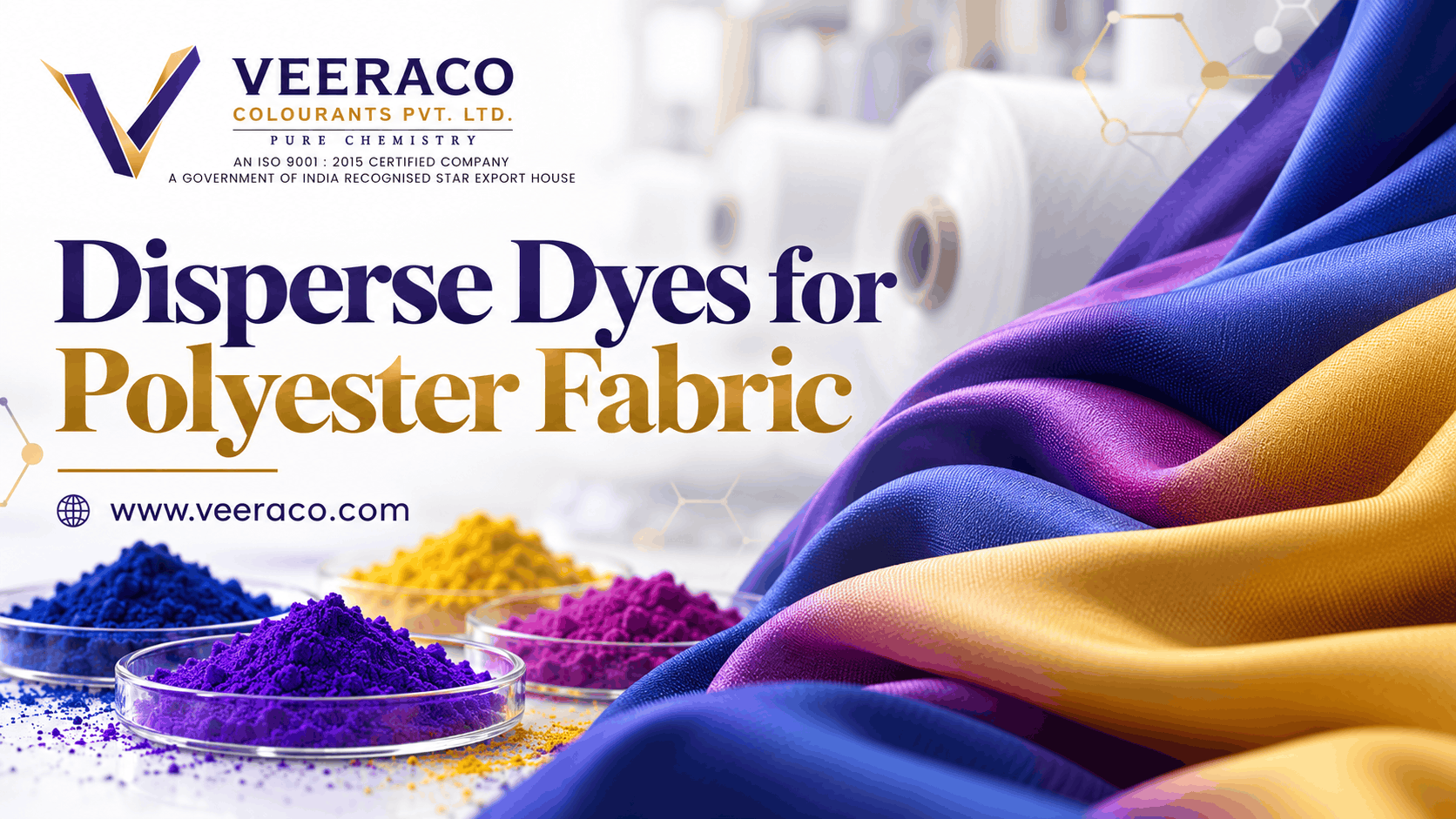
5. Disperse Dyes:
Non-ionic, sparingly soluble dyes designed for hydrophobic synthetic fibers (polyester, nylon, acetate). Disperse dyes consist of very fine dye particles that are dispersed in water with surfactants and then applied at high temperature. When polyester is heated above its glass transition (e.g. 120–130°C under pressure), disperse dye molecules diffuse into the amorphous regions of the fiber and are trapped by hydrophobic and Van der Waals forces. Disperse dyes give good wash and light fastness on synthetics, and because they dissolve fully in the fiber (rather than chemically bonding), they produce bright, uniform shades on polyester clothing, printed fabrics, and technical textiles. According to Alfa Chemistry, disperse dyes “are specifically engineered for the coloration of hydrophobic synthetic fibers such as polyester, nylon, cellulose acetate, and polyamide” and dye by molecular dispersion. (These dyes also see niche use in plastics and films for coloration.)
6. Vat Dyes:
Insoluble dyes (often anthraquinone-based) applied via a redox process. In dyeing, a vat dye is first reduced (e.g. with sodium hydrosulfite) in an alkaline bath to a soluble leuco form, which can penetrate the fiber. Once inside, it is oxidized back to its original insoluble form, trapped in the fiber. The classic example is indigo (for denim), but modern vat dyes include many other blues, greens, and blacks. The key advantage of vat dyes is extremely high wash and light fastness (excellent durability). This process produces rich, durable colors on cotton and other cellulosic fibers. The trade-off is that vat dyeing is a multi-step chemical process requiring reducers and careful handling. Industrially, vat dyes are standard for high-performance workwear, denim (indigo) and garments requiring outstanding washfastness.
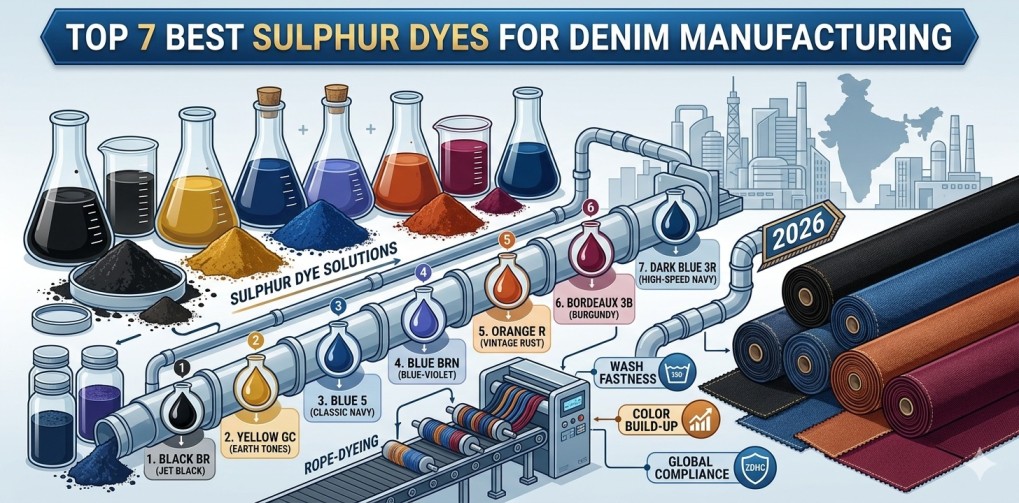
7. Sulfur Dyes:
Similar to vat dyes in that they are applied by reduction and oxidation, sulfur dyes are mostly used for inexpensive, dark colors on cotton (notably black, navy, dark green). They are generally easier to apply than vat dyes, but yield lower brightness and can give a more brownish tone. Sulfur dyes are favored for their economy and deep shades, but they have drawbacks: poor lightfastness on lighter colors, sensitivity to chlorine bleach, and odor/smoke during processing. Typical applications include navy and black cotton garments (e.g. workwear, hosiery) where cost is critical.
8. Mordant Dyes:
A somewhat historical class, mordant dyes are organic dyes that require a metal mordant (e.g. alum, iron, chrome) to fix the color on the fiber. These dyes have chelating groups that form insoluble complexes with metal salts and fiber – this “metal-dye-fiber” complex is very durable. In practice, mordant dyes were widely used on wool and silk (and some cotton) to achieve highly wash- and light-fast colors, especially in the pre-synthetic era. For example, aluminum mordants used with logwood or madder gave vivid purples and reds. Modern industry mostly uses reactive or vat dyes instead, but mordant dyes still see niche use for specialty applications (traditional textiles, leather finishing, archival papers) where their light- and wash-fastness is unmatched. (Note: “azoic” dyes are related – they are formed on the fabric by coupling two components – and were historically used on cotton with mordants.)
9. Azoic Dyes:
(Also known as naphthol dyes.) Azoic dyes are produced on the fiber itself by coupling a diazotized aromatic amine with a coupling component (like a naphthol) impregnated in the fabric. This creates an insoluble azo dye within the fiber. The process yields bright reds, oranges and browns with excellent fastness on cotton. Azoic dyeing is a specialized two- or three-bath process (e.g. naphthol & fixer in one bath, then coupling agent) and is mainly used for prints and high-quality cotton goods. (While not as common today, industrial in-line azoic processes are used in some textile mills for deep, fast reds and oranges on cotton.)
10. Solvent Dyes:
Organic dyes fully soluble in non-polar solvents. Unlike all the above (water-based) dyes, solvent dyes are used for coloring plastics, waxes, lubricants, fuels, and inks. They dissolve at the molecular level in hydrocarbon media, producing transparent, brilliant colors. For instance, solvent dyes are commonly used to color PVC, polyethylene, printing inks, and colored fuel additives (like red dye in diesel). According to industry sources, “Solvent dyes are colorants that dissolve fully into the host medium, giving plastics, printing inks, and coatings their characteristic transparency, brightness, and consistent shade”. They are not used for textiles (since they do not dissolve in water) but are critical in paint and plastic manufacturing.
Natural Dyes vs Synthetic Dyes
Natural dyes (from plants, insects or minerals) and synthetic dyes each have pros and cons. Natural dyes are renewable and often biodegradable, which appeals to eco-conscious markets, but they tend to have narrower color ranges and less consistency. They often require mordants (metal salts) to bond to fiber, as noted in textile history. Synthetic dyes, on the other hand, offer a vast palette of stable colors and are formulated for specific fastness attributes. They can be precisely manufactured with high purity and are well-suited to large-scale, repeatable production. Most industrial applications rely on synthetic dyes for uniformity and performance. In practice, a company may choose a natural dye only for niche uses (e.g. traditional textiles, certified eco products) while for mass-market fabrics or plastics they use synthetic dyes. For example, Veeraco Colourants as an ISO 9001:2015 certified manufacturer provides synthetic dyes across categories (acid, reactive, solvent, etc.) precisely because they meet stringent quality and regulatory standards.
Applications and Uses of Dyes
Different industries use different dye classes based on substrate and requirements. In textiles, virtually every class of dye is used:
- Textiles: Cellulosic fabrics (cotton, linen, rayon) typically use reactive, direct, vat or sulfur dyes for washfast apparel, while wool and silk use acid or basic dyes for rich tones. Polyester and nylon rely on dispersed dyes (or, for nylon, acid dyes). For example, reactive dyes dominate cotton T-shirts and denim, acid dyes color silk scarves and wool suits, and disperse dyes color polyester sportswear. Many finishing steps (bleaching, after-treatments) support these processes.
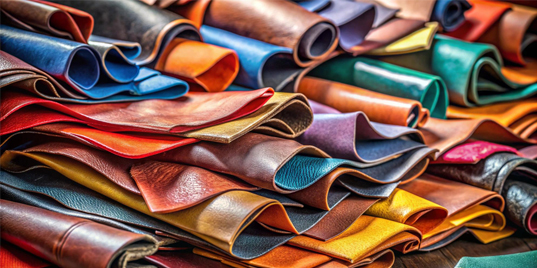
- Leather: Acid and basic dyes are common in leather dyeing because they penetrate tanned hides well. Mordant dyes can also be used for high-end leather. Leather goods like shoes and bags often rely on acid dyes for brilliant shades and fastness.
- Plastics & Polymers: Solvent dyes are key here. If color is needed in plastic (e.g. colored PVC pipes, nylon containers, ABS components), compatible solvent dyes or pigments are used. Disperse dyes can color synthetic fiber-reinforced polymers. Veeraco notes that it supplies solvent dyes used “in inks, plastics, petroleum and fuels”.
- Paints & Coatings: Organic solvent-soluble dyes are used for clear varnishes and stains, while pigments or solvent dyes color paints. High-performance coatings (e.g. wood finishes, industrial paints) often need dyes or pigments that resist solvents and UV.
- Printing Inks & Paper: Water-soluble dyes (reactive, direct, basic) color paper products (tissue, writing paper, packaging). Pigments and solvent dyes are used in packaging inks and labels. Veeraco’s portfolio explicitly lists pigments and dye mixtures for inks and packaging.
- Food & Beverage: Only approved food-grade colorants are used here. These are a special subset of dyes (like FD&C colors) that are certified for safety. Veeraco even produces food colors – e.g. synthetic food dyes that meet standards – separate from its industrial dyes.
- Rubber & Fuel: Non-polar (solvent) dyes color rubber compounds, fuels and lubricants (for identification). For instance, diesel fuel is often dyed red with a solvent-soluble dye.
In short, substrate determines dye: cellulose → reactive/direct/vat/sulfur; protein → acid/basic/mordant; synthetic fiber → disperse/acid; plastics/fuels → solvent; paper → reactive/basic, etc. Each application also has performance needs (lightfastness for outdoor fabrics, washfastness for garments, chemical resistance for coatings). Companies like Veeraco serve all these sectors – for example, it advertises reactive dyes for textiles, leather, paper and inks, and basic dyes for textiles and paper mills.
How to Choose the Right Dye
Choosing a dye starts with the material and end-use. Key factors include:
- Fiber/Polymer Type: Cotton vs wool vs polyester require different chemistries. For instance, trying a disperse dye on cotton will fail (no affinity). Consult substrate compatibility (e.g. “use reactive dyes for cotton”).
- Fastness Requirements: If heavy laundering is expected, select high-fastness dyes (reactive or vat for cotton; high-grade acid for wool). For outdoor use, UV-stable dyes (anthraquinone pigments or solvent dyes for plastics) are necessary.
- Processing Conditions: Do you have hot dye vats, reducing baths, or only mild conditions? Sulfur and vat dyes need strong alkali and reducing agents, so they require the right equipment. Reactive dyes need precise pH control.
- Color/Shade Needed: Some pigment/dye chemistry yields brighter pastels, others deliver dark depths. For example, basic dyes give unmatched brightness on acrylics; vat dyes offer the deepest blacks.
- Quality and Consistency: Industrial users demand consistent lots. This is where suppliers matter. Veeraco (for instance) emphasizes ISO-registered quality control: every batch is tested for shade, purity and strength, ensuring repeatability for large orders.
- Regulatory Compliance: For food or toys, only certified dyes are acceptable. Even industrial dyes must meet local standards (REACH, etc.). Many manufacturers like Veeraco provide technical data and certificates for their dye products.
The ideal dye is one that exactly matches fiber type, fulfills performance specs, and is cost-effective at scale. Consulting technical charts or supplier data sheets is standard practice. Many dye companies (including Veeraco) offer technical support to help customers select the right class and shade for their process.
Advantages and Limitations of Different Dyes
Each dye class has trade-offs:
- Acid Dyes: Pros: Water-soluble, vibrant on wool/nylon, good overall fastness. Cons: Only for proteins/nylon, moderate lightfastness.
- Basic Dyes: Pros: Extremely bright, strong on acrylics, good lightfastness on synthetics. Cons: Poor washfast on cellulose, limited to certain fibers (acrylic, some wool/silk).
- Direct Dyes: Pros: Cheap, easy use on cotton, wide color range. Cons: Weak washfastness (needs after-treatment), poor chlorination fastness.
- Reactive Dyes: Pros: Excellent washfastness and bright colors on cellulose; wide range of shades. Cons: Sensitive to hydrolysis (waste), require precise pH management; not suitable for all fabrics.
- Disperse Dyes: Pros: Only practical option for polyester/acetate, good fastness, range of colors. Cons: Require high-temp dyeing, risk of migration (can bleed in washing or ironing if misapplied).
- Vat Dyes: Pros: Outstanding wash and light fastness, deep colors (classic blues/blacks). Cons: Complex processing (reduction/oxidation, strong chemicals), limited fiber use (mostly cotton).
- Sulfur Dyes: Pros: Very inexpensive, dark shades (especially black). Cons: Fumes in processing, mediocre fastness (especially on lighter colors), strong odor and COD in effluent.
- Mordant Dyes: Pros: High fastness and rich hues on wool/silk, historic significance. Cons: Use of toxic metals (chromium, copper, etc.), extra mordanting steps; mostly obsolete in modern mass production.
- Azoic Dyes: Pros: Vivid colors (reds/oranges), very good fastness on cotton. Cons: Multi-step process; less versatile (cotton only), largely replaced by direct/reactive dyes.
- Solvent Dyes: Pros: Excellent for non-polar media (plastics, inks); bright transparent colors; easy to use (dissolve, no binder needed). Cons: Not for water-based systems; can have environmental/health issues (VOC, toxicity) if not properly managed.
In a procurement context, these advantages inform sourcing: for example, a plastic molder needs high-heat-stable solvent dyes (like certain anthraquinones), whereas a textile house might favor reactive dyes for cotton blends due to their durability. Suppliers address these requirements: Veeraco, for instance, certifies its dyes (ISO 9001) and tests each batch for fastness and purity, underscoring the importance of quality control.
Conclusion
Coloration is a core part of manufacturing – it affects not only how products look but also how they perform. Understanding the different types of dyes helps industrial professionals choose the right colorant for each material and application. Each dye class represents a compromise of properties (fastness, ease of use, cost), and the “best” dye depends on the job: fiber type, process, and end-use requirements. Sourcing the appropriate dye involves evaluating supplier quality (e.g. ISO certification, test data) and ensuring compliance (e.g. REACH, food-grade). Companies like Veeraco Colourants illustrate this approach: they offer a wide dye portfolio, technical support for selection and shade matching, and stringent quality control (every batch tested for strength, shade, purity before dispatch). In the end, well-informed choices lead to durable, vibrant products – and that matters for any manufacturer or buyer who relies on color for performance and appeal.
For more information, technical data, or custom color development, consult a knowledgeable dyes supplier with the relevant industry certifications (for example, Veeraco Colourants is an ISO 9001:2015 certified supplier with extensive export experience).



Frequently Asked Questions
A dye is a soluble substance (usually organic) that can chemically or physically bond to a material to impart color. Unlike pigments (insoluble particles), dyes penetrate and attach to fibers or substrates.
There’s no single fixed number; dyes can be classified variously. In textile practice, about 10–15 major classes are recognized (acid, basic, reactive, direct, vat, sulfur, disperse, pigment, etc.). Different sources count differently. For this article, we cover ten key classes listed above. Each class is defined by its chemistry and application method.
The main industrial dye classes include acid, basic, reactive, direct, disperse, vat, sulfur, mordant (and related azoic), and solvent dyes. (Other categories like pigments, optical brighteners and specialized dyes exist, but these are the major application classes for textiles and industrial materials.)
Natural dyes come from plants, animals or minerals and were used historically; synthetic dyes are man-made organic chemicals developed since the 19th century. Synthetic dyes offer more consistency, brightness and range, while natural dyes are more eco-friendly but limited in shades and often require mordants.
Textile mills use multiple dye classes. Cotton fabrics: reactive and direct dyes (for colorfast apparel), vat/sulfur (for darks), and disperse dyes for polyester blends. Wool/silk: acid and basic dyes. Nylon: acid dyes. Technical textiles: sometimes disperse or specialty solvent dyes. In short, cotton and cellulosics see reactive, direct, vat/sulfur, while protein fibers see acid/basic. Companies like Veeraco supply many of these – e.g. its product line includes acid dyes for wool/nylon and reactive dyes for cotton (as cited above).