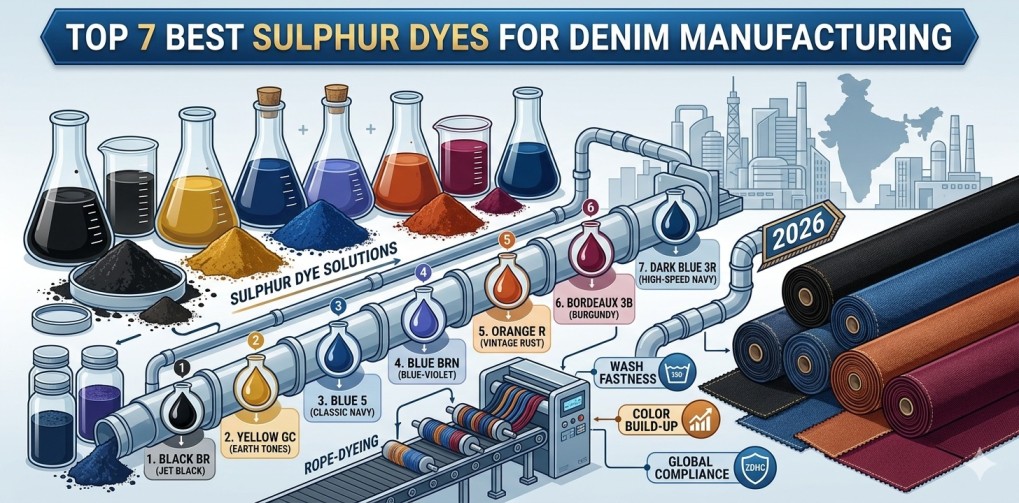
Top 7 Best Sulphur Dyes for Denim Manufacturing: A Complete Buyer's Guide for 2026
- Admin
- Mar 28, 2026
Walk into any denim factory, whether it is in Ahmedabad, Bangladesh, or Vietnam, and one thing is constant: the smell of sulphur dyes. That sharp, distinctive smell tells you something important is happening. These dyes are responsible for the rich blacks, deep navies, earthy oranges, and moody burgundies that define so much of the denim we wear every day.
But here is the problem. With dozens of sulphur dye variants available in the market, choosing the wrong one can cost you more than just money. Wrong dye selection leads to uneven shade lots, poor wash performance, customer returns, and sometimes full fabric rejections. For any denim manufacturer, whether you are running a small processing unit or a large-scale garment exporting house, picking the right dye is as critical as the weave of the fabric itself.
This guide breaks down the best sulphur dyes for denim India and global markets, explains what each dye actually does, and tells you exactly which supplier to contact for each one. No jargon, no fluff, just straight and useful information you can act on.
What Are Sulphur Dyes and Why Does Denim Love Them?
Before diving into the list, let us spend a moment understanding what makes sulphur dyes so popular specifically in denim production.
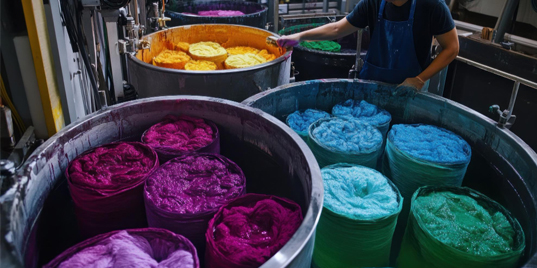
Sulphur dyes are a class of synthetic dyes that work by penetrating deep into cotton fibre. They are applied in a reducing alkaline bath, typically using sodium sulphide or a safer alternative like glucose-based reducers, and then oxidised on the fabric to lock in the colour.
Here is why denim manufacturers prefer them over other dye classes:
- Cost-efficiency: Sulphur dyes are significantly more affordable than vat dyes or reactive dyes, yet they deliver excellent depth of shade.
- Good wash fastness: Once fixed on fabric, they hold up well across multiple wash cycles, which matters enormously in denim where wash-down effects are a design feature, not a flaw.
- Build-up capability: You can layer sulphur dyes to achieve deeper, richer shades without dramatically increasing dye concentration.
- Versatility: From jet black and deep navy to orange rust and bordeaux, sulphur dyes cover a wide enough colour range to serve most denim colour palettes.
For anyone involved in sulphur dyes for denim manufacturing, understanding these basics is the foundation of making smarter purchasing decisions.
What to Look for Before You Choose a Sulphur Dye
Not all sulphur dyes are created equal. Here are the key factors every buyer should evaluate before placing an order:
- Wash Fastness Rating: In denim, colour change on washing is often intentional, but it must be controlled. A dye with poor wash fastness will bleed unpredictably and fail QC audits. Always ask your supplier for fastness data sheets.
- Build-Up Performance: If you need deep shades like jet black or dark navy, you need a dye that builds up efficiently. Poor build-up means you use more dye to get less colour, which kills your margins.
- Reduction Sensitivity: Some sulphur dyes are more sensitive to over-reduction, which causes dull or greenish hues. Know your dye’s reduction tolerance before you scale up production.
- ZDHC Compliance: If you are supplying to international denim brands, especially European fast fashion or premium labels, your dye must come from a ZDHC compliant dye supplier. ZDHC, or Zero Discharge of Hazardous Chemicals, is now a non-negotiable compliance standard for most global buyers. Always verify certification before you commit.
- Supplier Reliability: For large runs, you need consistent lot-to-lot colour. A supplier who cannot guarantee batch consistency is a liability. Ask for shade cards across multiple production batches before you finalise.
When you put all this together while sourcing the best sulphur dyes for denim India, you will make far fewer costly mistakes on the production floor.
The Top 7 Sulphur Dyes for Denim Manufacturing
Here is the core of this guide. Each entry covers what the dye does, why it matters in denim, and who supplies it reliably.
1. Sulphur Black BR: The Backbone of Every Denim Shade Room
If there is one dye that every denim mill stockpiles without question, it is C.I. Sulphur Black BR. This is the industry standard for achieving deep, jet-black denim, the kind of black that stays rich even after 20 wash cycles.
Why It Works So Well for Denim
Sulphur Black BR has exceptional build-up properties. Mills can achieve very deep shades with relatively economical dye concentrations. More importantly, it washes down beautifully, making it the go-to dye for vintage-wash and distressed denim aesthetics that continue to dominate global denim fashion trends.
Brands that want that authentic, aged black denim look, the kind you see in premium streetwear and heritage denim labels, rely heavily on this dye for their base dyeing. It also performs consistently in rope dyeing as well as open-width dyeing processes, giving mills flexibility.
- Recommended Supplier: Shijiazhuang Yanhui Dye Co.
- Website: www.yanhuidye.com
- Contact: +86-189-3118-6269 / +86-181-3211-2519
Yanhui Dye is a well-known Chinese manufacturer with a strong export track record. For Indian buyers importing from China, they are a frequently referenced name in sulphur black procurement.
2. Sulphur Yellow GC: For the Earth-Tone Trend That Is Not Going Away
Earthy tones, vintage khaki, and mustard-cast denim are not going anywhere. If your collection leans into these directions, Sulphur Yellow GC is the dye you need in your recipe.
Why It Works So Well for Denim
Sulphur Yellow GC is not just a single-shade dye. Its real value lies in blending. When combined with blacks, browns, or oranges in a dye recipe, it contributes to complex, multi-tonal earthy finishes that look far more interesting than flat synthetic shades. Fashion-forward denim manufacturers use it to create that lived-in or sun-faded visual effect that resonates strongly with contemporary buyers.
Its colour penetration is consistent, which means you get uniform distribution across the fabric. This is critical for open-width fabrics where streaking is a common quality complaint.
- Recommended Supplier: Matalia Impex
- Website: www.mataliaimpex.net
- Contact: 07942666666
Matalia Impex is an India-based dye supplier, making it a convenient option for mills looking to reduce import lead times and work with a local procurement partner.
3. Sulphur Blue 5: The Foundation of Classic Navy Denim
Navy denim is a perennial bestseller. Season after season, navy blue remains one of the most commercial denim shades globally, and Sulphur Blue 5 is often the first dye that goes into the vat when a mill is building a navy or deep blue recipe.
Why It Works So Well for Denim
Sulphur Blue 5 is widely used as a base for indigo-blended denim fabrics. In mills that use both indigo and sulphur dyes together, a common practice for certain shade effects, this dye acts as the foundation layer that gives depth without clashing with indigo’s characteristic blue cast.
Its colour fastness under industrial laundry conditions is consistently rated high, which is why garment exporters who supply to buyers with strict wash testing protocols prefer this dye for navy-blue programmes.
- Recommended Supplier: China Interdyes
- Website: www.chinainterdyes.com
- Contact: 0086-15958136613
China Interdyes is a specialist dye exporter known for sulphur dye ranges. They are regularly referenced by Indian importers in the textile dye trade.
4. Sulphur Blue BRN: When Premium Denim Needs That Blue-Violet Depth
Standard navy is one thing. Premium denim is another. If you are manufacturing for a brand that wants a moody, sophisticated dark blue with a slightly violet undertone, Sulphur Blue BRN is the dye that delivers that aesthetic.
Why It Works So Well for Denim
The blue-violet cast of Sulphur Blue BRN makes it particularly attractive for premium and luxury denim segments. It adds sophistication to dark wash programmes without requiring additional overdyeing. The dye also has excellent build-up performance, meaning mills can achieve very deep shades while using less dye, an important cost control factor when margins are tight on premium programmes.
Designers and merchandisers in premium denim often describe the shade effect of BRN as having more character than standard navy, and that character is exactly what premium brands pay for.
- Recommended Supplier: P.D. Industries
- Website: www.tradeindia.com
- Contact: 08047665562
P.D. Industries is listed on TradeIndia and caters primarily to domestic Indian buyers. For mills that prefer sourcing locally with shorter payment cycles, they are worth contacting.
5. Sulphur Orange R: The Dye Behind the Vintage Rust Trend
Rust. Amber. Earthy burnt orange. These are the shades that have dominated street fashion and festival denim for the past three to four seasons. Behind most of these shades is Sulphur Orange R.
Why It Works So Well for Denim
Sulphur Orange R is extremely versatile in denim applications. It is used both as a standalone shade for full orange-cast denim and more commonly as a component in complex recipe blends to create brownish-orange, rust, and tobacco tones. The aged denim aesthetic, where the fabric looks like it has been worn through dusty roads and sun exposure, relies heavily on this dye.
Streetwear designers who chase earthy, vintage palettes specifically request sulphur orange-based recipes from their denim mills. It is one of those dyes that sits at the intersection of fashion relevance and technical simplicity.
- Recommended Supplier: Veeraco Colourants
- Website: www.veeraco.com
- Contact: +91-9372699096
Veeraco Colourants, based in Ahmedabad, is one of India’s well-regarded sulphur dye manufacturers and exporters. They supply to both domestic mills and international buyers across 50+ countries. For Indian denim manufacturers, sourcing from Veeraco cuts down significantly on procurement lead times and import complexities.
6. Sulphur Bordeaux 3B: For Collections That Need a Fashion Edge
Not every denim programme is about blue or black. There is a growing demand, particularly in women’s denim, premium capsule collections, and festival fashion, for rich, wine-toned, rustic red-cast denim. Sulphur Bordeaux 3B is the dye that makes this possible.
Why It Works So Well for Denim
This is a specialist dye that delivers unique depth in the burgundy and red-cast spectrum on cotton denim. Its wash resistance is notable, as shades retain their richness even after aggressive wash-down processes that would destroy a less stable dye. For fashion-forward denim collections where the colour itself is the design statement, Sulphur Bordeaux 3B gives manufacturers a tool to create denim that truly stands out on a retail rack.
It is the kind of dye that small-batch premium manufacturers reach for when they want to differentiate their product from commodity denim.
- Recommended Supplier: Sanhuan Colorchem
- Website: www.cncolorchem.com
- Contact: +86-532-88978177
Sanhuan Colorchem is a Chinese specialty dye manufacturer with exports to multiple countries. They are known for their range of specialty sulphur dyes and are particularly relevant for buyers who need reliable supply of less-common shades like Bordeaux.
7. Sulphur Dark Blue 3R: The Workhorse for High-Speed Production
When you are running high-volume, high-speed garment dyeing operations and you need deep navy at scale without sacrificing colour quality or breaking your cost structure, Sulphur Dark Blue 3R is your answer.
Why It Works So Well for Denim
This dye is specifically optimised for the demands of high-throughput denim processing. It yields deep navy results consistently, even at the fast dye-cycle speeds that large manufacturing facilities require to meet export order timelines. Cost efficiency without colour compromise is the core value proposition here.
Large-scale production facilities, particularly those running export programmes for European or US mid-market denim brands, prefer this dye for their core navy blue repeat programmes precisely because it performs reliably shift after shift, batch after batch.
- Recommended Supplier: Veeraco Colourants
- Website: www.veeraco.com
- Contact: +91-9372699096
Again, Veeraco Colourants appears here as the recommended supplier, a testament to the breadth of their sulphur dye portfolio for denim applications. Indian mills in particular benefit from working with an established domestic supplier for both cost and logistics reasons.
Quick Comparison Table
| Dye Name | Best For | Key Benefit | Supplier |
|---|---|---|---|
| C.I. Sulphur Black BR | Jet black, distressed denim | Deep shade, excellent wash-down | Shijiazhuang Yanhui Dye Co. |
| Sulphur Yellow GC | Earth tones, vintage blends | Multi-tonal penetration | Matalia Impex |
| Sulphur Blue 5 | Classic navy, indigo blends | High colour fastness | China Interdyes |
| Sulphur Blue BRN | Premium dark blue-violet | Rich build-up, less dye used | P.D. Industries |
| Sulphur Orange R | Rust, amber, vintage | Versatile in blends | Veeraco Colourants |
| Sulphur Bordeaux 3B | Burgundy, red-cast fashion denim | Unique depth, wash resistant | Sanhuan Colorchem |
| Sulphur Dark Blue 3R | High-speed bulk navy dyeing | Cost-efficient, consistent | Veeraco Colourants |
How to Pick the Right Sulphur Dye for Your Denim Line
With seven strong options on the table, how do you decide which ones belong in your dye house? Here is a practical way to think about it.
Match the dye to your end product. If you are running a basics programme, classic blue jeans, black jeans, or standard navy, you need Sulphur Black BR, Sulphur Blue 5, and Sulphur Dark Blue 3R in your stockroom. These are your workhorses. If you are running a fashion programme, seasonal colours, premium collections, or limited-edition washes, add Sulphur Blue BRN, Sulphur Bordeaux 3B, and Sulphur Orange R to your range.
Consider your production scale. Small-batch specialty dyeing and large-scale continuous dyeing have different requirements. Some dyes, like Dark Blue 3R, are specifically optimised for high-speed processes. Others, like Bordeaux 3B, are better suited for short-run fashion programmes where precision matters more than throughput.
Always trial before you bulk order. Request lab samples and shade cards. Run a trial batch before committing to large procurement quantities. This is especially true when you are working with a new supplier or switching between dye manufacturers.
Finding the best sulphur dyes for denim India is not just about the dye itself. It is about finding the right combination of dye performance, supplier reliability, and value for your specific production context.
Conclusion
Denim manufacturing is a competitive business. Margins are tight, buyer expectations are high, and the wrong dye decision can set you back by weeks and lakhs. The seven dyes covered in this guide represent the core of what works, dyes that professional denim mills across India and globally rely on for consistent results.
Whether you need the deep, reliable black of C.I. Sulphur Black BR, the earthy vintage tones of Sulphur Orange R, or the premium depth of Sulphur Blue BRN, the right dye for your programme is on this list. Start with your end product in mind, match the dye to the aesthetic and production process, and always verify supplier credentials before committing to bulk orders.
If you are actively looking for the best sulphur dyes for denim manufacturing in India, especially from reliable domestic suppliers with a proven export track record, Veeraco Colourants is a strong place to start your conversation.
The right dye, sourced from the right supplier, is one of the simplest but most impactful decisions you can make for your denim business.




Frequently Asked Questions
Yes, when used correctly and within regulated concentrations. However, older formulations using sodium sulphide as the reducing agent raise environmental concerns. Modern processes use eco-friendly reducing agents. Always check your dye supplier's safety data sheets and ensure compliance with your buyer's chemical restrictions.
Sulphur Black BR is the most widely used dye for black denim fabric. It delivers deep, jet-black shades with excellent wash-down performance, making it the top choice for both basic black denim and distressed or vintage-wash programs. It is cost-effective, easy to process, and available from multiple suppliers across India and China.
ZDHC stands for Zero Discharge of Hazardous Chemicals. It is a program adopted by major global apparel brands to ensure that hazardous chemicals are eliminated from textile supply chains. If you supply to international fashion brands, sourcing from a ZDHC compliant dye supplier is not optional. It is a basic requirement. Ask your supplier for their ZDHC Manufacturing Restricted Substances List (MRSL) conformance documentation before purchasing.
Yes, and this is actually quite common. Sulphur dyes are often used as a bottom shade under indigo or as a top shade over indigo to achieve complex colour effects that indigo alone cannot produce. Sulphur Blue 5 is particularly popular in indigo-blended recipes.
Greening is a common problem where sulphur black fabric develops a greenish cast after washing or prolonged storage. It is typically caused by over-oxidation or incorrect pH during processing. Using a properly buffered aftertreatment bath and following recommended fixation protocols from your dye supplier significantly reduces this risk.
For sulphur dyes for denim manufacturing in India, domestic suppliers like Veeraco Colourants offer the obvious advantages of shorter lead times, no import duties, easier returns management, and INR-based payments. Chinese suppliers often offer competitive pricing on volume, but the total landed cost when you factor in freight, duties, and lead time can sometimes close the gap significantly.