Textile Dyes Exporters to America: A Buyer’s Guide
- Veeraco Colourants
- Oct 10, 2026
Buying textile dyes for an American production line is rarely just a matter of finding a colour at the right price. A dye may look correct in a sample room and still behave differently when used on a production machine, a different fibre blend, or a larger batch.
For procurement teams, the real question is therefore not simply, "Who exports textile dyes to America?" It is, "Which supplier can provide the right dye, consistent quality, appropriate documentation, and dependable supply for the intended process?"
This is where textile dyes exporters from India can become relevant to American buyers. India has an established colourant and chemical manufacturing sector, with exporters supplying dyes and related products to international markets. But geographical availability alone is not enough. The supplier must understand shade requirements, fibre compatibility, application conditions, quality control and export documentation.
For a buyer evaluating textile dyes exporters to America, the most practical approach is to assess the complete supply chain rather than judging a supplier only by catalogue size or quoted price.
What Are Textile Dyes?
Textile dyes are colourants designed to impart colour to textile fibres, yarns or fabrics through a dyeing process. Unlike pigments, which generally remain physically dispersed on or within a substrate and often require a binder, dyes are selected for their ability to interact with particular fibres or textile substrates.
The chemistry matters because not every dye works equally well with every fibre.
A cotton mill, for example, may require a dye system capable of interacting effectively with cellulose. A polyester processor has different requirements because polyester is hydrophobic and generally relies on disperse dyes. Wool and nylon can require acid dye systems, while acrylic fibres commonly use cationic dyes.
The choice also affects more than colour. Dye selection can influence exhaustion, fixation, wash-off, migration, levelness, fastness and processing conditions.
For a procurement professional, this means the product specification should begin with the application rather than the shade name.
A useful purchasing discussion should establish the fibre, dyeing method, target shade, required fastness, process conditions and relevant technical specifications before a bulk order is considered.
Types of Textile Dyes Used in the Textile Industry
Different textile fibres and processes require different dye classes. Understanding the basic differences makes it easier to evaluate textile dye manufacturers and exporters.
Reactive Dyes
Reactive dyes are widely used for cellulose fibres such as cotton because the dye can chemically bond with the fibre under suitable dyeing conditions.
They are commonly considered where bright shades, good wash fastness and a broad shade range are required. The actual performance depends on the specific dye chemistry, process control, fixation conditions and after-treatment.
For cotton processors, important purchasing parameters can include shade strength, compatibility with the dyeing process, fixation behaviour, reproducibility and fastness performance.
Vat Dyes
Vat dyes are water-insoluble dyes that are converted into a soluble form during the dyeing process and subsequently oxidised back to their insoluble form within the fibre.
They are particularly associated with cotton and other cellulose applications where high levels of fastness are important. Denim is one of the most recognisable applications, although vat dyes are used across other textile processes as well.
The reduction and oxidation stages need careful process control. A buyer should therefore evaluate the dye not only by colour but also by how reliably it performs under the intended process conditions.
Sulphur Dyes
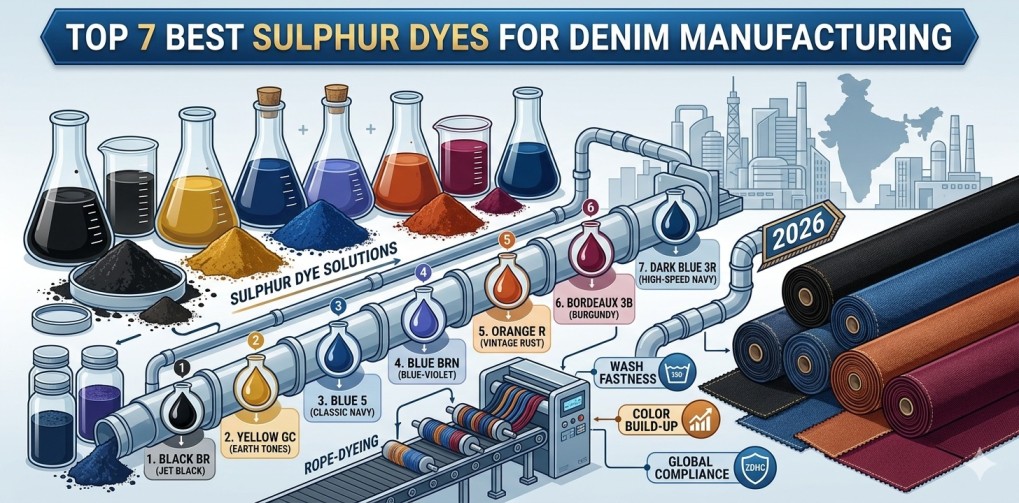
Sulphur dyes are mainly associated with cellulose fibres and are widely used where economical dyeing of darker shades is required.
They are common in applications involving cotton fabrics and workwear, including darker black, navy and related shades. The dyeing process normally involves reduction followed by oxidation.
For bulk procurement, consistency between batches becomes particularly important because a small variation in shade strength or processing behaviour can become significant when a large quantity of fabric is being produced.
Disperse Dyes
Disperse dyes are primarily used for hydrophobic synthetic fibres, particularly polyester.
Because polyester has low affinity for conventional water-soluble dyes, disperse dyes are formulated to disperse in the dye bath and penetrate the fibre under appropriate conditions.
For polyester processors, selection can involve considerations such as temperature stability, dispersion, shade reproducibility, migration behaviour and required fastness properties.
This is a good example of why simply asking for a "blue textile dye" is insufficient. The same colour requirement can involve completely different chemistry depending on the fibre.
Acid Dyes
Acid dyes are generally used with fibres such as wool, silk and nylon under acidic dyeing conditions.
They are relevant to textile applications where fibre affinity, shade clarity and specific fastness characteristics are required. The correct pH range and dyeing conditions depend on the product and substrate.
For wool and other protein-based fibres, the dyeing process must be controlled carefully to obtain level shades without unnecessarily affecting the material.
Basic and Cationic Dyes
Basic and cationic dyes are positively charged colourants used for substrates with suitable anionic sites. Cationic dyes are particularly important for acrylic and modacrylic fibres.
They are known for producing strong, bright shades on compatible substrates. However, high affinity can also make process control important, particularly when uniformity and level dyeing are required.
The practical lesson across all these dye classes is straightforward: the correct dye is determined by the fibre, process and performance requirement, not by colour alone.
Why Source Textile Dyes from India?
India has a substantial chemical and colourant manufacturing base, making it an important sourcing location for international buyers looking for dyes and related specialty chemicals.
For American buyers, working with textile dyes exporters India can provide access to manufacturers and suppliers with experience across multiple dye categories and industrial applications.
However, sourcing from India should not be approached simply as a cost-saving exercise.
A reliable international supply relationship depends on technical communication, product consistency, documentation, packaging, logistics and the supplier's ability to understand the buyer's application.
Indian suppliers can also be relevant where buyers need several dye categories from the same sourcing region. A textile group may use reactive dyes for cotton, disperse dyes for polyester and acid dyes for particular nylon or wool applications. Having access to multiple product categories can simplify supplier evaluation and procurement.
The important distinction is between a supplier that merely trades a product and one that can support the technical and quality requirements associated with repeat industrial supply.
What American Buyers Should Look for in a Textile Dyes Exporter
Choosing among textile dye suppliers in India requires more than comparing quotations. Several practical factors should be evaluated before moving from sampling to regular purchasing.
Product Consistency
Batch-to-batch consistency is one of the most important considerations in textile dye procurement.
A dye that performs correctly during laboratory trials but changes in strength or shade from one batch to another can create production problems. The effect becomes more serious when the same colour must be reproduced across multiple production runs.
Buyers should therefore ask how the supplier defines product specifications, how batches are tested and how deviations are handled.
Shade Matching
Colour matching is not simply a matter of looking at a catalogue shade.
Actual shade perception can change with fibre type, concentration, dyeing conditions, lighting and finishing. A physical sample or reference standard is therefore often more useful than a printed colour chart.
For custom requirements, buyers should establish whether the supplier can evaluate a physical sample and confirm whether the requested shade can be reproduced consistently before committing to a larger order.
Technical Documentation
A professional supply relationship should provide access to appropriate technical information.
Depending on the product, this may include a Technical Data Sheet, Safety Data Sheet, Certificate of Analysis, product specification and application information.
Documentation becomes particularly important when products are being reviewed by technical, procurement, quality and regulatory teams in different organisations.
Quality Control
Quality control should be considered at the batch level rather than assumed from the supplier's reputation.
Useful questions include: What parameters are tested? At what stage is testing performed? Is each batch tested before dispatch? Can the supplier provide a Certificate of Analysis for the shipment?
For colourants, relevant parameters can include shade, strength, purity, moisture and other product-specific characteristics.
Packaging and Bulk Supply
Packaging needs to protect the dye during storage, handling and transportation.
The appropriate packaging depends on the physical form and characteristics of the product. Bulk buyers should also confirm packing sizes, labelling, palletisation where applicable, shipping requirements and minimum order quantities before finalising the commercial arrangement.
Export Experience
International chemical shipments require more coordination than a domestic purchase.
An exporter should understand commercial documentation, shipping terms, packaging requirements and communication with freight and customs stakeholders.
The buyer should also clarify whether the supplier can support the documentation needed for the destination market and whether the proposed product has previously been supplied to comparable international applications.
How to Choose the Right Textile Dyes for Your Fabric
The fibre should normally be the starting point for dye selection.
Cotton
Cotton is a cellulose fibre and is commonly dyed with reactive, vat and sulphur dyes depending on the desired shade, fastness, cost and process.
Reactive dyes are widely considered for bright and varied shades, while vat and sulphur dyes are frequently selected for applications where their particular fastness or processing characteristics are appropriate.
Polyester
Polyester generally requires disperse dyes.
The dye must be compatible with the polyester substrate and the selected dyeing method. Temperature, dispersion, shade reproducibility and fastness requirements should be considered before approving a product for production.
Wool
Wool can be dyed using acid dyes and other dye systems suited to the fibre.
Because wool is sensitive to processing conditions, temperature, pH and handling need to be controlled carefully. The buyer should assess both colour requirements and the effect of the process on the fabric.
Nylon
Nylon is commonly associated with acid dyes, although the appropriate system depends on the specific substrate and performance requirement.
Important considerations can include shade build-up, levelness, wet fastness and compatibility with the production process.
Blended Fabrics
Blended fabrics are more complicated because two or more fibres may respond differently to the same dye.
A polyester-cotton fabric, for example, may require a combination of dye systems or a process designed to colour each component appropriately.
This is one situation where laboratory trials become especially valuable. A dye that works well on a single-fibre fabric cannot automatically be assumed to provide the same result on a blend.
Key Considerations When Importing Textile Dyes from India to America
Importing textile dyes involves both commercial and technical considerations. Buyers should establish the requirements for the specific chemical and intended use before shipment.
Product Specifications
The purchase specification should identify the exact product, colour or shade, grade, physical form, application, packaging and relevant test parameters.
Where possible, the buyer and supplier should work from the same specification rather than relying only on a commercial product name.
Safety Data Sheets (SDS)
For hazardous chemicals, Safety Data Sheets are an important part of hazard communication. OSHA's Hazard Communication Standard requires chemical manufacturers and importers to evaluate hazards and provide appropriate labels and SDS information for hazardous chemicals.
For an international buyer, an SDS should be reviewed before shipment rather than treated as paperwork that can be addressed afterward.
The document should correspond to the actual product being supplied and provide the information needed by the receiving organisation for handling, storage and workplace safety.
Technical Data Sheets (TDS)
An SDS focuses primarily on safety and hazard communication. A Technical Data Sheet serves a different purpose.
A TDS may provide information about product characteristics, recommended application, physical properties, typical specifications or other technical information relevant to use.
The exact information varies by product. Buyers should request the current TDS for the specific dye rather than relying on a generic document.
Certificate of Analysis (COA)
A Certificate of Analysis provides batch-specific information against defined quality parameters.
For industrial buyers, this can help connect the material received with the specification agreed during procurement. The parameters included should be relevant to the particular product and its intended application.
A COA should not replace incoming quality checks where those checks are part of the buyer's quality system.
Packaging and Shipping
Packaging, labelling and shipping arrangements should be confirmed before an order is dispatched.
The supplier and buyer should establish the agreed Incoterm, shipment quantity, packaging format, transport requirements and documentation.
For chemical imports, classification and transport requirements may depend on the actual product. This is another reason why product-specific documentation matters.
Regulatory and Compliance Requirements
US chemical imports can be subject to regulatory requirements depending on the substance, use and applicable exemptions.
The U.S. Environmental Protection Agency states that imports of chemical substances, mixtures or articles containing chemical substances must comply with the Toxic Substances Control Act, subject to applicable exclusions and exemptions. Import certification requirements can also apply.
The TSCA Inventory is an important reference for chemical substances covered by TSCA, but buyers should verify the status and requirements for the specific substance rather than assuming that all textile dyes are treated identically.
This is also why regulatory review should happen before the purchase order is finalised. The exporter, US importer and relevant compliance professionals may each have responsibilities that depend on the product and transaction.
Common Applications of Textile Dyes in the American Textile Industry
Textile dyes are used across a wide range of textile manufacturing processes.
They can be applied to fibres before spinning, to yarn during yarn dyeing, or to fabric during piece dyeing. They are also relevant to garment processing and specialised textile applications.
Cotton garments and home textiles may use reactive, vat or sulphur dye systems. Polyester sportswear and synthetic fabrics commonly require disperse dyes. Wool and nylon products can involve acid dye systems, while acrylic textiles may use cationic dyes.
The application can change the technical requirement.
A fashion garment may place strong emphasis on shade accuracy and appearance. Workwear may require particular wet or dry fastness. Home textiles can have repeated washing requirements. Industrial textiles may have additional exposure conditions.
Therefore, a buyer should define the end-use before selecting the dye. The same dye class can contain products with different performance profiles.
Why Indian Textile Dyes Exporters Can Be a Practical Sourcing Option
For American procurement teams, Indian textile dyes exporters can be a practical option when the supplier can combine manufacturing or controlled sourcing with technical support and export capability.
The strongest sourcing relationships are usually built around repeatability. A buyer needs to know that the next order will meet the same agreed specification and that technical questions can be addressed without starting the process again.
This is especially relevant for companies purchasing dyes in bulk. A small variation that seems insignificant in a laboratory sample can become costly when it affects thousands of kilograms of fabric.
The right question is therefore not whether India can supply textile dyes. It clearly has an established dye and chemical manufacturing sector. The more useful question is whether an individual supplier has the quality systems, technical communication and export process required for the buyer's specific application.
Veeraco Colourants: Dyes Manufacturer, Supplier and Exporter in India
One example of an Indian company operating across this broader colourant supply chain is Veeraco Colourants, a Mumbai-based manufacturer, exporter and supplier of dyes and pigments. The company states that it was founded in 1952 and currently serves customers across more than 50 countries.
Its product portfolio includes reactive, acid, basic, cationic, sulphur, vat and other dye categories, alongside pigments, optical brighteners and specialty colourants. Its stated industry coverage includes textiles as well as leather, plastics, paints and coatings, printing inks, paper and packaging, food, rubber and petroleum-related applications.
For a textile buyer, the more relevant point is its stated quality workflow. Veeraco separate QA and QC functions, with product standards and test methods managed through quality system and batch testing carried out in its in-house laboratory before dispatch. Veeraco identifies parameters such as shade matching, strength, purity and moisture among its QC checks.
That type of process is useful when an international buyer is evaluating textile dyes manufacturers in India, because the purchasing decision depends on more than the initial sample. The ability to connect a sample, specification, batch test and export shipment is what makes a colourant supply relationship workable at scale.
How to Request Textile Dye Samples and Technical Information
A good sample request should contain enough information for the supplier to understand the actual application.
Instead of simply asking for a "red dye," provide the fibre type, fabric construction where relevant, intended dyeing process, target shade, required fastness and any known technical specification.
If the requirement is based on an existing commercial shade, provide a physical sample or reference standard whenever possible. This gives the supplier a more useful basis for evaluation than a colour name alone.
Before moving to bulk purchasing, the buyer should also request the relevant technical documentation. Depending on the product, this may include the TDS, SDS, COA format, product specification and recommended application information.
A sensible sequence is to evaluate the sample under laboratory conditions, compare it against the agreed reference, conduct a production trial where necessary, and then approve the product against a defined specification.
Veeraco, for example, states that it supports shade matching, samples, technical documentation and export-ready consignments for international customers.
The principle applies regardless of supplier: approve the material against the application and specification, not merely against a catalogue image.
Conclusion
Sourcing textile dyes internationally becomes much easier when the decision moves away from price and catalogue size and toward application, consistency and documentation.
For American buyers, textile dyes exporters to America can differ significantly in their technical capability, quality systems and ability to support repeat orders. An Indian supplier can be a practical sourcing option, but the right choice depends on whether the supplier can meet the specific requirements of the fibre, dyeing process, shade, fastness, documentation and regulatory environment.
The most reliable approach is simple: define the application first, select the appropriate dye class, test the material against a reference, confirm the technical documentation, and establish the quality specification before moving into regular bulk supply.
Colour may be the visible part of a textile, but the reliability of that colour begins much earlier, with the chemistry, process control and discipline behind the supply chain.
For buyers evaluating a supplier for an ongoing requirement, a technical discussion with Veeraco Colourants can be considered as one sourcing option for textile dyes, samples and export requirements.













Frequently Asked Questions
Textile dyes exporters to America are manufacturers, exporters, suppliers or specialised trading companies that supply textile dye products to buyers in the United States. Indian suppliers are one potential sourcing group, particularly for buyers looking for manufacturers and exporters with experience in international chemical supply.
Common categories include reactive dyes, vat dyes, sulphur dyes, disperse dyes, acid dyes, basic dyes and cationic dyes. The appropriate category depends on the textile fibre, dyeing process, shade and required performance.
India has an established dyes and chemical manufacturing sector and a large range of dye and pigment products. Buyers may consider Indian suppliers for product availability, manufacturing capability, technical support, pricing, export experience and access to multiple colourant categories.
However, supplier evaluation should always be based on the individual product and its technical, quality and regulatory requirements.
The documents depend on the product, shipment and regulatory requirements. Common commercial and technical documents can include a commercial invoice, packing list, shipping documentation, SDS, TDS and Certificate of Analysis.
For US chemical imports, applicable TSCA requirements should also be reviewed for the specific substance and transaction.
The most practical approach is to evaluate a representative sample against an agreed specification and reference standard. Laboratory testing should consider the actual fibre and intended dyeing process.
For repeat supply, buyers should also review batch documentation and establish acceptance criteria for parameters relevant to the product, such as shade, strength, purity, moisture or other agreed specifications.