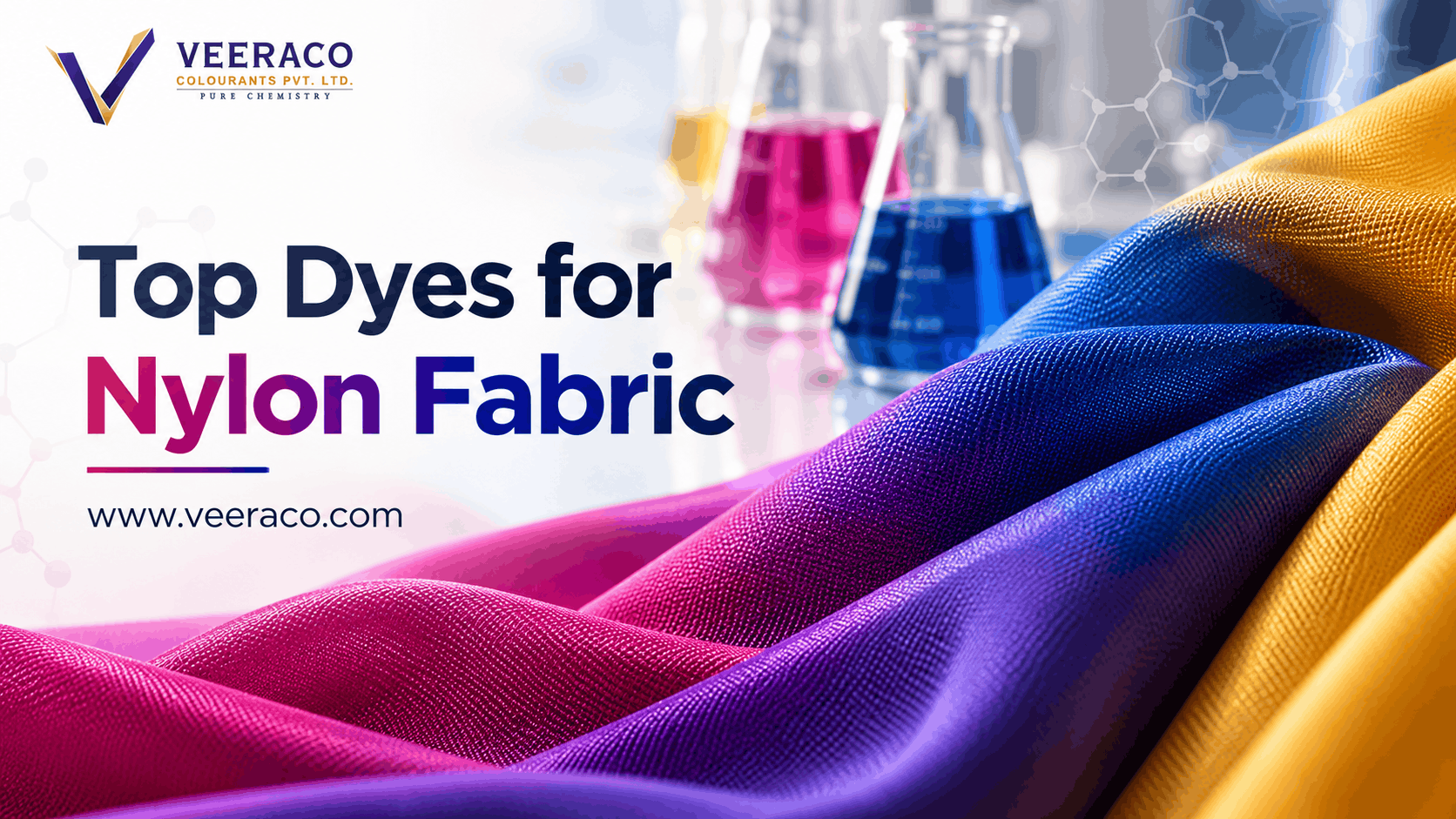
Top Dyes for Nylon Fabric
- Veeraco Colourants
- Oct 06, 2026
Nylon fabric can look simple after dyeing, but getting the shade right is rarely a simple colour-matching exercise. The chemistry of the fibre, the dye's affinity, the dyebath pH, temperature, fabric construction and final performance all influence what happens inside the dyeing machine.
For most conventional nylon fabrics, acid dyes are the primary choice. They have a strong affinity for polyamide fibres because nylon contains terminal amino groups that become protonated under acidic conditions, creating attraction with anionic dye molecules. Metal-complex acid dyes are considered where stronger wet and light fastness is required, while specialised reactive and disperse dyes have more defined applications.
That distinction matters because the dye that produces a beautiful laboratory shade is not automatically the dye that gives the right performance in production. In nylon dyeing, selection should begin with the fibre and end-use requirement, not simply with the colour card.
Why Dye Selection Matters When Dyeing Nylon Fabric
Nylon is a polyamide fibre rather than a cellulose or polyester fibre, and its chemical structure determines how colour is absorbed and retained. Commercially important nylon types such as PA6 and PA66 contain amide groups and terminal functional groups that influence their interaction with dyes. The terminal amino groups are particularly important for the uptake of anionic dyes such as acid dyes and certain reactive dyes.
This is why nylon behaves differently from cotton and polyester. Cotton is commonly dyed with reactive, direct, vat or other cellulose-compatible systems, while polyester is predominantly associated with disperse dyes. Nylon sits in a different chemical space. Acid, metal-complex, reactive and disperse dyes can all have roles in polyamide coloration, but their mechanisms and practical performance are not the same.
The construction of the material also changes the result. A tightly constructed woven fabric, a knitted sportswear fabric and a fine nylon yarn can respond differently to the same dye recipe. Fibre finish, heat setting, polymer characteristics and the concentration of amino end groups can also affect dye uptake and shade depth. Research on nylon 6 and nylon 66 shows that variations in fibre structure and amino end-group content can influence acid-dye substantivity.
This is one reason experienced dyers do not treat a dye recipe as a universal formula. A recipe is a starting point. The substrate decides how far that recipe can be trusted.
What Are the Top Dyes for Nylon Fabric?
When the question is which dyes are most relevant to nylon fabric, the practical answer is acid dyes first, followed by metal-complex dyes for selected fastness requirements, with reactive and disperse dyes used for more specialised purposes.
Acid Dyes for Nylon
Acid dyes are the most established dye class for conventional nylon fabric. They are water-soluble, anionic dyes that interact with protonated amino groups in the polyamide. Under acidic conditions, the amino end groups of nylon become positively charged, allowing electrostatic attraction with negatively charged groups in the dye.
This affinity makes acid dyes particularly useful when the requirement is a broad shade range combined with good penetration and controllable exhaustion. Different acid dye chemistries are designed for different levels of affinity and fastness, so the phrase "acid dye" covers a fairly wide performance range rather than one single type of product.
Leveling acid dyes are useful when uniformity and controlled migration are priorities. Higher-affinity systems can provide stronger dye uptake, but they may also require tighter control of acid addition, temperature and the rate of exhaustion. Research has shown that the rate and extent of acid-dye uptake on nylon are affected by dye affinity, temperature and dyebath acidity.
The limitation is that strong initial colour does not automatically mean excellent wet fastness. Some acid-dyed nylon systems can release colour during repeated washing, particularly at deeper shades. After-treatment and careful dye selection can improve performance, but the final requirement should always be tested on the actual substrate.
Metal-Complex Dyes for Nylon
Metal-complex dyes, especially 1:2 metal-complex systems, occupy an important position when fastness requirements become more demanding. These dyes contain a metal atom coordinated with the dye molecule and are designed to provide stronger overall performance than many conventional leveling acid dyes.
For nylon applications where wet fastness and light fastness are significant concerns, metal-complex dyes can be a useful option. Textile references identify 1:2 metal-complex dyes among the established dye classes for polyamide fibres, and research describes their use when a reasonable level of wet fastness is required.
Their trade-off is often process and shade behaviour. Some metal-complex systems can be slower in application and may provide a somewhat different colouristic character from highly brilliant acid dyes. For demanding shades, laboratory evaluation is therefore especially important before production approval.
Reactive Dyes for Nylon
Reactive dyes are more commonly associated with cellulose, but specialised reactive dye systems can also be applied to nylon. The reason is straightforward: nylon contains amino end groups that can provide substantivity for anionic reactive dyes, while appropriately designed reactive groups can contribute to chemical fixation.
The advantage is the potential for improved fixation and wet performance in suitably designed systems. The difficulty is that reactive dyeing of nylon is more formulation-dependent than conventional acid dyeing. Dye structure, molecular size and reactive-group behaviour can affect the efficiency of fixation. Research has shown that the molecular shape and type of reactive group can be important determinants of fixation.
Reactive dyes therefore make sense when the application justifies the additional process control. They should not simply be selected because the word "reactive" is associated with durable colour on another fibre.
Disperse Dyes for Nylon
Disperse dyes can also be used with polyamide fibres, but their role is more selective. Unlike acid dyes, disperse dyes are non-ionic and rely on the physical affinity of the dye for the fibre rather than the same ionic interaction that dominates conventional acid dyeing.
Polyamide references include disperse dyes among the dye classes applicable to nylon, and technical guidance notes their use particularly for lighter shades.
The important consideration is fastness. Traditional disperse dyeings on nylon may provide less satisfactory wash fastness, especially outside lighter shades, which limits their usefulness for applications where repeated wet treatment is severe.
In practice, disperse dyes are therefore better understood as a specialised tool rather than the default answer for nylon fabric dyeing.
How to Choose the Right Dye for Nylon Fabric
The best dye for nylon is determined by the relationship between the fibre, the shade and the final application.
Nylon 6 and nylon 66 should not automatically be treated as interchangeable substrates. Differences in polymer structure, terminal groups and processing history can influence dye uptake and colour behaviour. Even within the same polymer family, differences in amino end-group concentration can change the substantivity of anionic dyes.
Fabric construction is equally important. Fine filaments, textured yarns, knitted structures and dense woven fabrics can present different diffusion and levelness challenges. A dye that performs well on a laboratory knitted swatch may need recipe adjustment for a dense industrial fabric.
Shade depth is another major factor. Pale shades often allow more flexibility in dye selection, while deep shades place greater demands on exhaustion, fixation, penetration and fastness. In nylon, the available dye sites can also influence how readily very deep shades can be achieved with particular dye classes.
Dyeing equipment affects the decision as well. Jet, beam, package and other dyeing systems create different circulation and heat-transfer conditions. The selected dye must be compatible with the equipment's method of chemical addition, temperature control and material movement.
Finally, fastness requirements should be translated into actual tests. A sportswear fabric may require different performance from a carpet or a fashion lining. Wash, perspiration, rubbing and light fastness should be assessed against the requirements of the final product rather than treated as generic quality labels.
Acid Dyes vs Other Dyes for Nylon
The comparison below is a practical way to understand where the major dye classes fit.
Dye class | Main attraction for nylon | Typical consideration | General role
Acid dyes | Strong affinity and wide applicability | Control of exhaustion and wet fastness | Primary dye class for conventional nylon
Metal-complex dyes | Stronger fastness performance in selected systems | Shade character and process control | Applications requiring higher fastness
Reactive dyes | Potential chemical fixation | More specialised process and dye chemistry | Selected high-performance applications
Disperse dyes | Applicability to polyamide and lighter shades | Wet fastness can limit use | More specialised or lighter-shade applications
Acid dyes generally provide the most direct route for conventional nylon coloration because the chemistry is well matched to polyamide. Metal-complex dyes become more relevant as fastness requirements increase. Reactive dyes can be appropriate when specialised fixation chemistry is valuable, while disperse dyes have a narrower practical role. Textile industry technical references recognise all four classes within polyamide dyeing, while noting differences in application conditions and performance.
The key point is that there is no universal dye class that wins every comparison. The "right" dye changes with the specification.
Nylon Fabric Dyeing Process
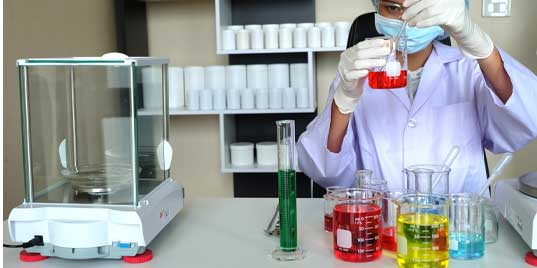
A reliable nylon fabric dyeing process begins before the dye is added. Fabric preparation should remove processing residues and ensure that the substrate can wet consistently. Pretreatment and heat setting history can influence the final result, particularly where fabric-related affinity differences are present.
The dye bath is then prepared with the selected dye, water and appropriate auxiliaries. For acid dye systems, pH is one of the most influential variables because it affects the charge state of the nylon and the rate at which dye is taken up.
The bath is normally operated under mildly acidic conditions, although the exact target depends on the dye chemistry. Veeraco Colourants' current acid dye information, for example, states a nylon working range of about pH 4.5 to 5.5 and a dyeing temperature of 95 to 100°C for its described nylon application. Published research on specific acid dyes also demonstrates that optimum conditions can differ by dye and process, with one recent PA6 study identifying pH 3 and 95°C as optimal for the particular system it examined.
This variation is important. A published process window should be treated as a technical reference rather than a universal production recipe.
Dye addition must allow the colourant to distribute before rapid exhaustion begins. The heating rate matters because a rapid rise in temperature can accelerate dye uptake and create unevenness if the fabric has not reached a sufficiently controlled state. Controlled exhaustion is therefore often more valuable than simply reaching the final temperature quickly.
After dyeing, rinsing and after-treatment can be used to remove loosely held colour and improve the final fastness profile. Washing, cooling and drying should also be managed consistently so that the final shade can be compared reliably with the approved standard.
Key Factors Affecting Nylon Dyeing Quality
pH is one of the most critical variables because acid dye uptake on nylon is strongly influenced by the protonation state of the fibre. Small changes in acidity can alter the rate of exhaustion and therefore the distribution of colour through the material.
Temperature affects both diffusion and dye uptake. As the fibre and dye system approach higher temperatures, molecular movement increases, but the benefit only comes when the dyeing profile is controlled. A technically sound recipe therefore specifies not only the final temperature but also how quickly the process reaches it.
Heating rate is particularly important for level dyeing. High-affinity dyes can exhaust quickly, so staged acidification or controlled temperature increase may be necessary to prevent premature uptake.
Liquor ratio affects concentration, circulation and chemical distribution. The correct value depends on the dyeing machine and fabric form, so it should be considered alongside the equipment rather than in isolation.
Dye concentration influences shade depth, but more dye does not always translate linearly into more usable colour. At higher depths, efficiency, site availability and unfixed dye become increasingly important.
Auxiliaries can support leveling, dispersion, wetting and migration. They should be selected according to the dye class and the substrate because excessive or incompatible auxiliary use can change exhaustion behaviour.
Water quality should not be overlooked. Hardness, dissolved salts and other impurities can interfere with reproducibility or alter the behaviour of sensitive formulations.
Fabric pretreatment is equally important. Differences in finishing history, heat setting and surface condition can create shade variation that is wrongly attributed to the dye itself. Experienced dyehouses generally investigate the substrate and process together.
Common Nylon Dyeing Problems and Their Causes
Uneven dyeing is usually a process-control problem rather than simply a colourant problem. Rapid exhaustion, poor fabric preparation, inadequate circulation or inconsistent temperature can cause the dye to enter the fibre unevenly.
Shade variation between lots can arise from differences in fibre properties, dye strength, moisture, process history or bath conditions. For industrial buyers, this is why colour strength and batch-to-batch consistency matter as much as the nominal dye identity.
Barré effects can appear when variations in fibre structure or dye affinity create visible stripes or differences in colour depth. Polyamide is particularly sensitive to material-related differences because dye uptake depends on the chemical and physical characteristics of the fibre.
Poor wet fastness may indicate that the chosen dye chemistry is not suited to the required end use, that the shade depth is too high for the system, or that after-treatment is insufficient. Research on acid-dyed nylon has repeatedly identified wet-fastness limitations as an important issue.
Poor light fastness is similarly linked to dye structure and application. A shade that performs well in washing may still fail the light-fastness requirement of an outdoor textile.
Staining often reflects unfixed or weakly held dye. This is particularly relevant when the textile will be washed alongside lighter materials.
Incomplete dye exhaustion can leave unwanted colour in the dyebath and produce both economic and wastewater-treatment implications. It may result from incorrect pH, temperature, dye compatibility or insufficient time for migration and diffusion.
Best Dyes for Nylon Fabric Based on Application
Apparel and fashion fabrics often place emphasis on shade accuracy, evenness, handle and reasonable wash fastness. Acid dyes are frequently considered first because they are well established on nylon and offer broad colour possibilities. The exact grade should then be chosen according to the garment's testing requirements.
Sportswear and swimwear create a more demanding environment because repeated washing, perspiration, exposure to chemicals and, in some cases, sunlight can affect colour. Here, a higher-fastness acid or metal-complex system may be considered depending on the specification.
Hosiery requires particularly careful control of levelness because even minor differences can become visible on fine, stretch-oriented constructions. Controlled exhaustion and good migration behaviour are therefore especially important.
Carpets may involve specially modified nylon substrates, including variants designed for deeper or differentiated dyeability. The dye selection must account for fibre modification, pile construction and the required resistance to light, cleaning and wear.
Nylon yarn dyeing requires close attention to package density, penetration and circulation. A dye that appears suitable from a fabric perspective may behave differently when applied to yarn packages where liquor flow and diffusion are more constrained.
Technical textiles usually place more emphasis on defined performance criteria than on colour alone. Depending on the application, this can include resistance to washing, perspiration, light, rubbing, heat or chemical exposure. For these products, dye selection should begin with the performance specification and work backward toward the chemistry.
How to Source Industrial Dyes for Nylon Fabric
Industrial dye sourcing should begin with technical documentation rather than a price comparison.
A proper technical data sheet should identify the dye's application area, shade information, recommended conditions and relevant quality parameters. Buyers should also establish whether the supplied product is consistent with the tested laboratory sample and whether the same manufacturing source can be maintained across repeated purchases.
Colour strength is particularly important. Two materials carrying the same Colour Index identification can still produce different practical results if their strength, purity or formulation differs. For production, reproducibility is usually more valuable than a nominal specification alone.
Fastness data should be reviewed against the final product requirement. Wash-fastness data, light-fastness data and perspiration or rubbing results should be interpreted according to the relevant testing method and substrate.
Regulatory requirements also need to be considered, particularly when the textile enters markets with restricted-substance requirements. Buyers should request the applicable compliance documentation rather than assuming that a general company-level certification covers every individual dye.
This is where a technical supplier can add value beyond simple product availability. Veeraco Colourants, for example, describes its acid dyes as applicable to nylon and publishes technical information covering application conditions and testing parameters. Its current company information also describes its role as a manufacturer, exporter and supplier of dyes and pigments, with technical support for shade matching and documentation.
For international and bulk procurement, documentation, consistency and traceability can become as important as the dye itself. Veeraco Colourants currently states that it supplies customers in more than 50 countries and provides certificates of analysis, safety data sheets and technical data sheets with consignments.
The practical lesson is simple: industrial sourcing should evaluate the complete supply package, not just the price per kilogram.
Conclusion
The search for the top dyes for nylon fabric becomes much clearer once nylon is treated as a specific chemical substrate rather than simply another synthetic textile.
Acid dyes remain the central choice for conventional nylon because their chemistry matches the polyamide fibre well. Metal-complex dyes provide another route when fastness requirements become more demanding. Reactive and disperse dyes have useful roles, but they belong to more specialised process conditions and applications.
The deeper lesson from nylon dyeing is that colour is only the visible result. The real decision is made through the interaction of fibre chemistry, dye structure, pH, temperature, process control and end-use performance. In industrial dyeing, consistency is rarely produced by choosing the most fashionable dye class. It comes from choosing a dye system that behaves predictably on the material that actually enters the machine.
For buyers evaluating industrial dyes for nylon, Veeraco Colourants provides technical documentation, shade-matching support and dye supply for industrial applications, making technical evaluation and supplier discussions a practical next step.

Frequently Asked Questions
For most conventional nylon fabrics, acid dyes are the primary dye class to consider because nylon's polyamide structure provides strong affinity for anionic dyes under acidic conditions. Metal-complex dyes may be considered when higher wet or light fastness is required, while reactive and disperse systems have more specialised uses.
Yes. Acid dyes are widely used for nylon because the amino end groups of polyamide become protonated under acidic conditions and interact with anionic dye molecules. This makes acid dyeing one of the most established methods for nylon coloration.
Yes, specialised reactive dye systems can be used on nylon. Their behaviour depends on dye structure, reactive groups and the process used to achieve fixation. They are better treated as a specialised option than as a direct replacement for conventional acid dyes.
Yes. Disperse dyes can be applied to polyamide, particularly in selected lighter-shade applications. However, their practical use on nylon is more limited than acid dyes because wet-fastness performance can be a concern with some systems.
There is no single universal pH for every nylon dye. Acid dye systems are generally applied under acidic conditions, with the exact target depending on dye affinity and process design. A current Veeraco Colourants technical description gives pH 4.5 to 5.5 for its stated nylon acid-dye application, while recent research on a specific PA6 acid dye found maximum colour yield at pH 3 under its tested conditions.
Near-boiling temperatures are common for conventional exhaust dyeing of nylon, but the precise temperature depends on the dye class, fibre type, machinery and recipe. Current Veeraco information describes 95 to 100°C for its stated nylon acid-dye application, while published studies also show that temperature and acidity work together to influence dye uptake.
Both are polyamide fibres and can be dyed with acid dyes, but their polymer structure, end-group concentration and processing history can affect dye affinity and colour behaviour. This is why a recipe developed for one nylon substrate should be validated before being transferred to another.
Improvement usually starts with selecting a dye designed for the required fastness level, followed by control of pH, temperature, exhaustion and after-treatment. Metal-complex systems can be considered where higher wet and light fastness is needed, but actual performance should be confirmed through laboratory testing on the finished substrate.