
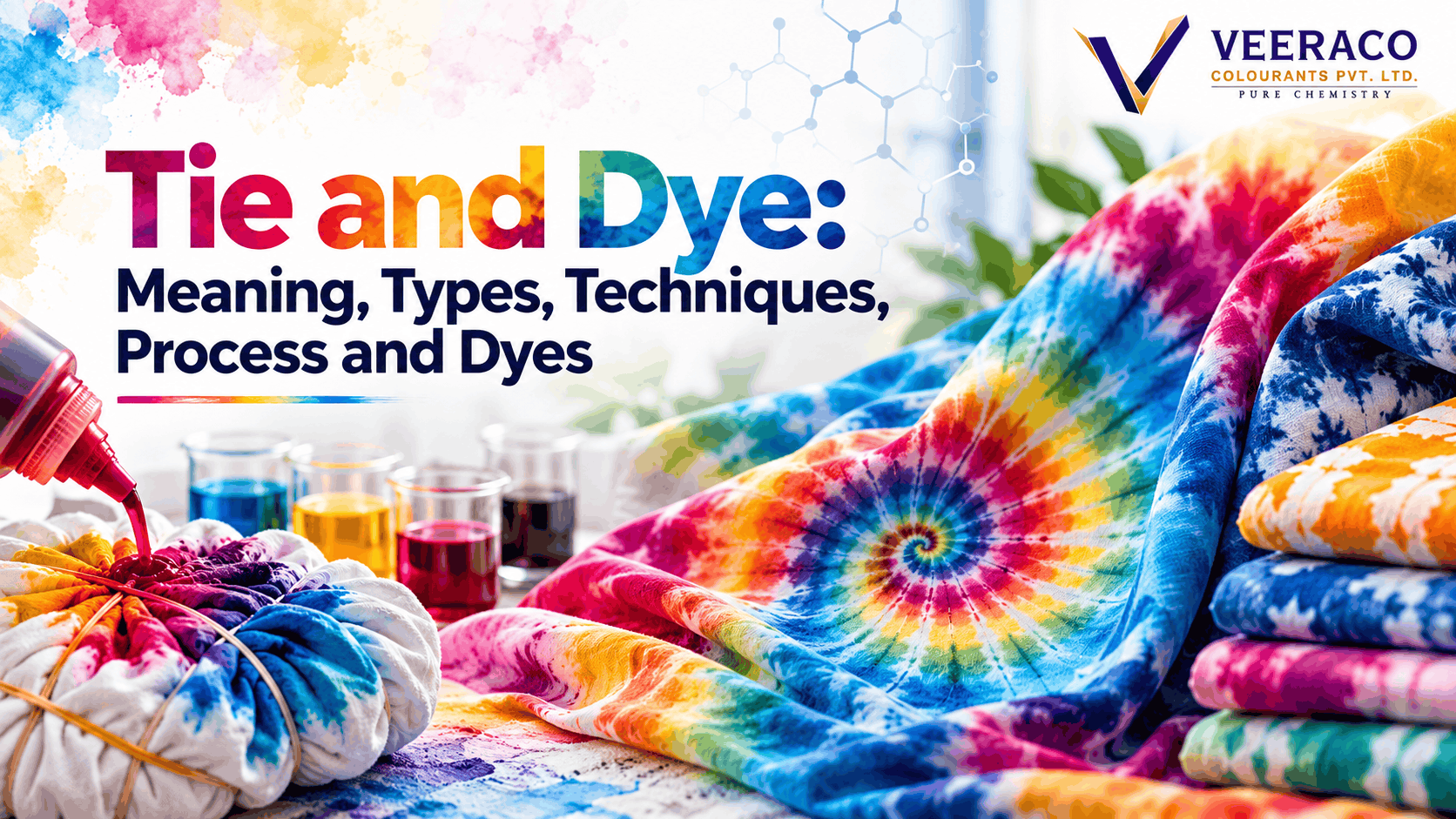
Tie and Dye: Meaning, Types, Techniques, Process and Dyes
- Veeraco Colourants
- Oct 05, 2026
There is something revealing about a piece of tie and dye fabric. The colour rarely appears perfectly uniform, and that is precisely the point. A fold, a tightly bound section, a loose thread or a small difference in dye penetration can change the pattern. What looks spontaneous on the finished fabric is often the result of several carefully controlled decisions.
That is why tie and dye remains relevant beyond craft and fashion. In textile processing, it demonstrates a basic principle of colouration: the final appearance depends not only on the colourant but also on the fibre, preparation, application method, fixation and finishing. Tie and dye is a resist-based textile coloration technique in which parts of the fabric are protected or restricted from dye penetration before colour is applied. The resulting contrast creates distinctive patterns across the material.
For manufacturers and textile processors, the more important question is not simply which colour to use. It is whether the selected dye is chemically suitable for the fibre, capable of producing the required shade, compatible with the process and able to meet the required performance after washing and finishing.
What Is Tie and Dye?
Tie and dye is a method of colouring fabric by manipulating the material before dye application. Sections of fabric are folded, twisted, gathered, stitched or tied so that dye reaches different areas to different degrees. After dyeing and subsequent processing, the restrained areas produce lighter, contrasting or uncoloured portions.
The technique is therefore a form of resist dyeing. The resistance does not always mean that dye is completely prevented from reaching a particular area. The tightness of the binding, fabric construction, dye mobility and application conditions can all influence how much colour penetrates the material.
This is why two pieces made using apparently similar tie and dye techniques can look different.
In commercial textile processing, this variation has to be understood rather than treated simply as an artistic accident. The required result may be intentionally irregular, but the underlying process still needs control.
The meaning of tie and dye is therefore broader than a pattern-making technique. It represents a relationship between fabric structure, resist formation and colour application.
History of Tie and Dye
Resist-based textile coloration has a long history across different regions and cultures. Before modern industrial dyeing systems, textile artisans developed methods of restricting colour penetration using folding, tying, stitching, binding and other forms of resist.
India has an especially important place in this history. Traditional textile practices such as Bandhani and Leheriya demonstrate how fabric manipulation can be used to create highly recognizable patterns. These techniques developed through craftsmanship and regional knowledge, with differences in tying, folding, material preparation and dye application contributing to distinctive visual results.
The continued use of these techniques also shows why textile coloration cannot be separated from material knowledge. The same dye behaves differently depending on the substrate and processing conditions.
Modern tie and dye may use industrial dyes, controlled equipment and standardized processes, but the underlying principle remains familiar: control where colour can penetrate and where it cannot.
This connection between traditional technique and modern chemistry is one of the more interesting aspects of textile dyeing. The equipment may change, but the basic challenge remains the same: achieving the intended colour and pattern without losing control over the material.
How Does the Tie and Dye Process Work?
The tie and dye process begins long before the fabric enters the dye bath. Fabric preparation, fibre composition and the way the material is manipulated all influence the final result.
Fabric Preparation
The fabric must first be prepared for coloration. Depending on the fibre and its previous processing history, preparation can involve cleaning, scouring or other treatments intended to remove substances that could interfere with dye uptake.
Oils, processing residues, dirt and other contaminants can affect how evenly colour reaches the fibre. A poorly prepared substrate can therefore create unevenness that may be mistaken for a dye problem.
This is one of the recurring observations in textile processing: when a shade does not behave as expected, the dye itself is not always the first place to look.
Folding, Twisting and Gathering
Once prepared, the fabric is manipulated to create the desired resist pattern. It may be folded into regular sections, twisted into a spiral, gathered into irregular forms or compressed in particular areas.
The geometry of this stage has a direct effect on the final design.
A tightly compressed area generally restricts dye movement more strongly than a loosely gathered section. The thickness of the fabric stack can also influence penetration. Consequently, pattern formation is partly a physical process before it becomes a chemical one.
Tying and Resist Formation
String, thread, bands or other binding materials can be used to hold the fabric in position.
The pressure applied during tying matters. If the binding is inconsistent, the resulting pattern may vary even when the same dye concentration is used.
For repeat production, this becomes an important process-control issue. Traditional tie and dye often values variation, while commercial production may require a defined range of acceptable variation.
Dye Application
The prepared material can then be exposed to the selected dye system using an appropriate application method.
The choice depends on the fibre, dye class, desired shade and process conditions. Application may involve immersion or other controlled approaches, depending on the material and production method.
The dye must reach the accessible fibre areas while the resist sections remain comparatively protected.
Fixation
Dye fixation is critical because colour on the fibre is not necessarily the same thing as colour properly fixed to the fibre.
Different dye classes require different conditions for fixation. Depending on the system, temperature, pH, time and chemical auxiliaries may influence the process.
The correct conditions must therefore be established for the specific dye and substrate rather than assumed from the colour name alone.
Washing and Finishing
After coloration and fixation, the material generally requires washing or other after-treatment to remove unfixed dye and processing residues.
This stage has a major effect on the final appearance. Excess unfixed colour can bleed during subsequent washing and can affect the appearance of lighter areas.
The finished fabric must then be assessed according to its intended use. A visually attractive pattern is only one part of successful textile coloration.
Materials Used for Tie and Dye
The materials used for tie and dye vary according to the scale and method of production, but the basic requirements revolve around the textile substrate, resist material and colourant.
The fabric is the primary substrate, and its fibre composition determines much of the dye-selection decision. Cotton, silk, wool, viscose and synthetic fibres do not respond identically to colourants.
Binding material is used to create the resist. Thread, string, bands and similar materials can influence the sharpness and consistency of the pattern.
The dye itself is perhaps the most misunderstood part of the process. There is no universal tie and dye colourant that performs equally well on every fabric. Dye selection must follow fibre chemistry and processing requirements.
Water quality can also matter, particularly in larger-scale processing. Minerals and other impurities can influence certain dyeing systems and may affect reproducibility.
Where industrial processing is involved, auxiliaries and process chemicals may also be required depending on the dye class and substrate.
The important point is that these materials work as a system. Changing the fibre without changing the dye system, or changing the dye without considering the process, can produce an inconsistent result.
Types of Tie and Dye
There is no single universal classification of tie and dye types because techniques are often classified according to the way the fabric is manipulated.
Spiral patterns are created by twisting the fabric around a central point. Crumple techniques gather fabric irregularly, creating less predictable colour movement. Folding and pleating create more structured patterns, while binding specific sections can produce circular or banded effects.
Stitch-resist techniques use thread and stitching to control which sections receive colour. Traditional Indian practices have their own methods and terminology, reflecting regional textile knowledge developed over generations.
The important distinction is that the technique controls the physical distribution of the colourant. The dye system then determines how the colour interacts with the exposed fibre.
Popular Tie and Dye Techniques
Tie and dye techniques can produce very different visual effects even when the same fabric and colourant are used.
A spiral technique creates radiating movement from a central point. Crumple techniques tend to create irregular, cloud-like distribution. Accordion folds produce more organized lines or bands, while circular binding can create concentric effects.
The degree of compression is particularly important. A tightly tied section may show a sharper resist boundary, whereas a looser section can allow partial penetration.
This is one reason why the phrase "tie and dye effect" can describe a wide range of appearances. The final effect is not determined by the dye alone. Fabric weight, construction, moisture, compression and dye mobility all contribute.
For industrial processors, repeatability becomes the practical challenge. A design may be intentionally irregular, but the degree of irregularity still needs to fall within the expectations of the customer or end market.
Tie and Dye Techniques in India
India's tie and dye traditions demonstrate how textile coloration can combine technical skill, regional identity and visual design.
Bandhani, commonly associated with Gujarat and Rajasthan, uses small areas of fabric that are tightly tied to create characteristic dotted patterns after dyeing. Leheriya is associated with patterned waves created through specific folding and tying practices.
These traditions are often discussed from a cultural perspective, but they also contain useful lessons about process control. The pattern begins with physical manipulation of the textile, and the dye only reveals the structure created by that manipulation.
Modern textile processing can approach the same principle with different materials and technologies. The chemistry may be more controlled, but the relationship between resist formation and colour penetration remains fundamental.
For anyone studying tie and dye in India, this connection is worth understanding. The technique is not simply a decorative style. It is a method of controlling textile coloration through material structure.
Which Fabrics Are Suitable for Tie and Dye?
The most suitable fabric depends on the desired appearance, dye system and intended end use.
Cotton
Cotton is one of the most commonly associated substrates with tie and dye. As a cellulose fibre, it can be coloured using dye systems designed for cellulose chemistry, including reactive dyes and, depending on the application, direct dyes.
Reactive dyes are particularly important where strong fibre-dye interaction and suitable wash fastness are required under the relevant process conditions.
Silk
Silk is a protein fibre and requires a different approach to dye selection. Acid dyes are commonly used for protein fibres, while certain reactive dye systems can also be suitable depending on the product and process.
Because silk has different physical and chemical characteristics from cotton, simply transferring a cotton dyeing procedure to silk is not appropriate.
Wool
Wool is also a protein fibre and is commonly associated with acid dye systems.
Temperature control becomes particularly important because wool is sensitive to processing conditions. The desired shade must be achieved without compromising the characteristics of the fibre.
Viscose and Rayon
Viscose is regenerated cellulose, so its dyeing behaviour has similarities to other cellulose-based materials while still presenting its own processing considerations.
Reactive dyes can be relevant where the process and product specification support their use.
Synthetic Fibres
Synthetic fibres require more specific consideration. Polyester, for example, is commonly coloured using disperse dyes because of the chemical nature of the fibre.
Acrylic fibres are generally associated with cationic or basic dye systems.
The practical lesson is straightforward: choose the dye according to the fibre first, then optimize the process around the selected dye system.
Which Dyes Are Used for Tie and Dye?
There is no single dye class that is universally suitable for tie and dye. The appropriate dye depends primarily on the fibre, application process, fixation method, shade requirement and required fastness.
For cotton and other cellulose fibres, reactive dyes are an important option because they can form a chemical bond with the fibre under suitable conditions. Direct dyes can also be considered for certain cellulose applications where the required performance and process are appropriate.
For wool and silk, acid dyes are commonly used. Their suitability comes from the interaction between the dye and the chemistry of protein fibres.
Polyester requires a different approach, with disperse dyes being commonly used because of their suitability for hydrophobic synthetic fibres.
Acrylic fibres are generally coloured using cationic dye systems.
The colourant category is therefore only the beginning of the selection process. A procurement team looking for a "red dye for tie and dye" has not yet provided enough information for a technically sound recommendation. The supplier needs to know the fibre, application method, target shade, process conditions and performance requirements.
That is where technical sourcing becomes more important than simply comparing colour names or prices.
How to Choose the Right Dye for Tie and Dye
The right dye begins with fibre compatibility.
Once the substrate is known, the selection process should consider the desired shade depth, application method, fixation conditions, wash-off requirements and final performance.
For manufacturers, colour fastness is particularly important. The required level depends on the end use. A decorative textile that receives limited handling has different requirements from a garment that will undergo repeated washing and exposure to light.
Process conditions also matter. Temperature, pH, time and chemical auxiliaries can affect dye behaviour. A dye that performs well under one set of conditions may not produce the same result when the process changes.
Shade matching is another practical consideration. In commercial textile production, the challenge is rarely producing colour once. The challenge is producing it repeatedly.
This is why experienced colourant sourcing often involves laboratory samples, technical documentation, shade references and batch testing before a product moves into larger-scale production.
Veeraco Colourants, for example, operates across several dye categories and supports applications where shade matching, technical documentation and quality evaluation are relevant to industrial sourcing. Its stated quality system includes separate QA and QC functions and in-house batch testing before dispatch. This is an example of why supplier evaluation should consider technical control alongside product availability.
The principle is simple: the lowest-cost colourant is not necessarily the lowest-cost solution if it creates inconsistent shades, additional correction work or avoidable production losses.
Tie and Dye Colours: What Affects the Final Shade?
The phrase "tie and dye colors" often suggests that colour selection is primarily an aesthetic decision. In production, it is more complicated.
The same nominal colour can appear differently depending on the fibre, dye concentration, fabric preparation and application conditions.
A tightly compressed section may receive less colour than a loosely tied area. A dye with strong fibre affinity may behave differently from one that remains more mobile during application. The depth of shade can also change with concentration and fixation conditions.
Colour combinations introduce another layer of complexity. When multiple dyes are applied, their individual behaviour and interaction with the substrate need to be considered.
For this reason, successful colour development involves both visual judgment and process knowledge.
The term "tie and dye colours" covers everything from strong contrasting combinations to subtle tonal effects. Achieving either consistently requires understanding what is happening between the colourant and the textile.
Factors That Affect Tie and Dye Colour Quality
Colour quality begins with fabric preparation. Residual oils, finishes or contaminants can interfere with dye uptake and produce uneven results.
The selected dye system is equally important. A colourant must be compatible with the fibre and the intended processing conditions.
Concentration affects shade depth, but increasing concentration does not automatically produce a proportionally better result. The relationship between dye concentration, fibre capacity and process conditions must be understood for the specific system.
pH and temperature can be particularly important because different dye classes respond differently to processing conditions. Fixation time and temperature also influence the amount of colour that becomes sufficiently associated with the fibre.
Washing is another important stage. Unfixed or loosely held colour can affect bleeding, rubbing performance and the appearance of lighter areas.
Finally, quality needs to be judged against the end use. Light fastness, wash fastness, rubbing fastness and other properties may matter differently depending on the final product.
For a manufacturer, colour quality therefore means more than a visually pleasing shade. It means achieving a controlled and repeatable result that meets the performance expectations of the finished textile.
Applications of Tie and Dye in Textiles
Tie and dye has applications across fashion and textile products where patterned coloration is part of the desired appearance.
It can be found in apparel, scarves, decorative fabrics, home textiles and artisan textile products. Contemporary textile designers also use resist-based techniques to create effects that combine traditional methods with modern colour palettes and materials.
At a larger production scale, the challenge is maintaining the intended design while controlling variables that influence colour consistency.
This distinction between handcrafted and industrial production is important. Handcrafted variation may be part of the value of the product. Industrial processing generally requires more defined parameters, even when the final appearance is deliberately irregular.
Tie and Dye vs Conventional Textile Dyeing
Tie and dye and conventional textile dyeing serve different purposes.
Conventional dyeing often aims for relatively uniform colour across the textile. Process control therefore focuses heavily on even dye uptake, shade consistency and reproducibility.
Tie and dye deliberately introduces variation through resist formation. The objective is not uniformity across the entire surface but controlled contrast and pattern.
This means the two approaches cannot be judged using exactly the same criteria.
A conventional dyeing process may consider unevenness a defect. In tie and dye, controlled unevenness may be the intended visual outcome.
The technical challenge in both cases is still similar at a deeper level: the processor needs to understand how the colourant interacts with the substrate and how processing conditions influence the final result.
For tie and dye, however, there is an additional physical variable because the structure of the fabric itself determines where the dye can travel.
Conclusion
Tie and dye remains interesting because it sits between structure and unpredictability. The finished pattern can appear spontaneous, but the result is shaped by deliberate decisions about fabric, resistance, colourant and process.
For textile professionals, that distinction matters. A successful tie and dye process is not simply about selecting attractive colours. It requires the right relationship between fibre chemistry, dye selection, fabric preparation, application, fixation, washing and the performance expected from the finished material.
The same principle applies to industrial colour sourcing more broadly. A dye should be evaluated in the context of the substrate and process rather than as an isolated product. Shade consistency, technical documentation, quality control and repeatability can become just as important as the initial colour match.
The enduring value of tie and dye lies in this combination of craft and technical discipline. Traditional methods show how closely colour and material have always been connected. Modern dye chemistry gives manufacturers greater control over that relationship, but it does not remove the need to understand it.
For manufacturers, processors and buyers evaluating dye systems for textile applications, that understanding is often the difference between simply adding colour and achieving the intended result. When sourcing dyes or developing a new textile coloration process, working with a technically capable colourant supplier such as Veeraco Colourants can provide a practical starting point for evaluating suitable dye categories, samples and application requirements.





Frequently Asked Questions
Tie and dye is a resist-based textile coloration technique in which sections of fabric are folded, twisted, gathered, stitched or tied before dye is applied. The restricted areas receive less colour, creating contrasting patterns.
Tie and dye is not made from one specific material. It involves a textile substrate, a suitable dye system, binding or resist materials and, depending on the process, water and chemical auxiliaries.
Common materials include fabric, dyes, thread or binding materials, water and suitable process equipment. Industrial processes may also use specific auxiliaries depending on the fibre and dye class.
Cotton, silk, wool, viscose and some synthetic fibres can be used for tie and dye, but the appropriate dye system differs according to the fibre. Fabric construction and the intended end use also influence selection.
The dye depends on the fibre. Reactive and direct dyes can be relevant to cellulose fibres, acid dyes are commonly used for wool and silk, disperse dyes are associated with polyester, and cationic dyes are commonly used for acrylic fibres.
Tie and dye can be classified according to how the fabric is manipulated, including spiral, crumple, folding, pleating, binding and stitch-resist techniques. Traditional regional techniques also have their own classifications and names.
The basic process involves preparing the fabric, manipulating and tying it to create a resist, applying a suitable dye, fixing the colour where required, washing away unfixed colour and finishing the textile.
India has several traditional resist-dyeing practices associated with tie and dye. Bandhani or Bandhej and Leheriya are among the better-known Indian textile traditions associated with tying, folding or manipulating fabric before dyeing.