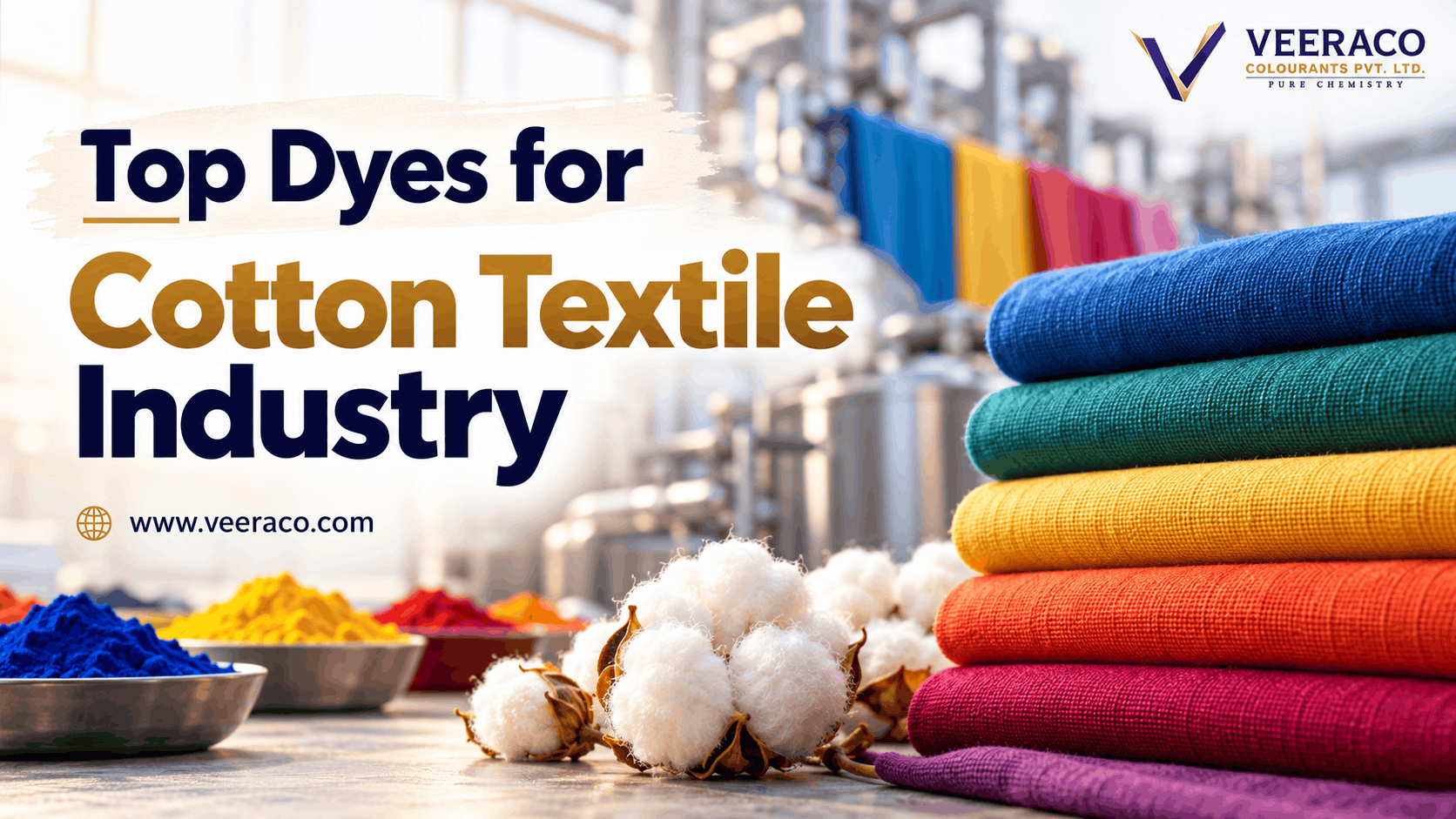
Top Dyes for Cotton Textile Industry
- Veeraco Colourants
- Oct 06, 2026
Cotton can take colour beautifully, but getting the right colour into the fibre and keeping it there through washing, finishing, sunlight and repeated use is a different challenge. In commercial textile production, the dye is not selected simply because it produces an attractive shade. The real decision sits at the intersection of fibre chemistry, process conditions, fastness requirements, production economics and the intended life of the fabric.
So, what are the Top Dyes for Cotton Textile Industry?
For most cotton textile applications where a broad shade range, strong wash fastness and reproducible colour are required, reactive dyes are generally the strongest all-round choice. However, vat dyes remain important where very high wet and light fastness is needed, direct dyes can be useful for economical and relatively simple processing, sulphur dyes remain significant for economical dark shades, and pigments are particularly relevant to cotton printing rather than conventional fibre dyeing. CottonWorks identifies reactive, direct, vat and sulphur dyes among the principal colourants used for cotton and other cellulosic fibres.
The important point is that there is no single best dye for cotton fabric in every situation. A dye that works extremely well for a T-shirt may not be the right answer for workwear, denim, towels, home textiles or a printed cotton article.
Why Dye Selection Matters in the Cotton Textile Industry
In a textile mill, colour is only one part of the result. The finished fabric must meet a specification.
A buyer may require a particular shade under defined lighting conditions. The production team may need a dye that performs consistently across a large batch. The garment brand may specify washing, rubbing or light fastness. A printing operation may prioritise surface colour, sharpness and handle. A mill may also be working within limits on water, energy, chemicals and processing time.
This is why cotton dye selection is ultimately a performance decision.
Cotton is a cellulose fibre, and different classes of dyes interact with cellulose in very different ways. Reactive dyes chemically bond with the fibre. Direct dyes are attracted to cellulose through weaker interactions. Vat and sulphur dyes are applied through reduction and oxidation chemistry. Pigments, by contrast, are not fibre dyes in the conventional sense. They remain substantially on the textile surface and depend on a binder system.
That distinction matters on the production floor. A dye can look excellent in a laboratory beaker and still create problems when scaled to thousands of metres of fabric.
Experienced dyers tend to ask a different question from simply, “Which colour do we need?” The better question is, “What performance must this colour deliver after the textile has been processed and used?”
What Are the Top Dyes Used for Cotton Textiles?
The principal types of dyes for cotton include reactive dyes, vat dyes, direct dyes and sulphur dyes. Pigments also have an important place in cotton textile printing.
Each group has a different balance of colour strength, affinity, fastness, process complexity and cost.
| Dye class | Main characteristic on cotton | Typical strength | Common use |
|---|---|---|---|
| Reactive dyes | Forms a covalent bond with cellulose | Broad shade range and good wash fastness | Apparel, home textiles, knitted and woven cotton |
| Vat dyes | Insoluble colourant applied through reduction and oxidation | Very high wet and strong light fastness | Denim, workwear, high-fastness textiles |
| Direct dyes | Direct affinity for cellulose | Simple and economical application | Economical cotton fabrics, lighter shades |
| Sulphur dyes | Reduced to soluble form and oxidised after application | Economical dark shades | Blacks, navy and selected utility fabrics |
| Pigments | Surface coloration using a binder | Useful for printing and certain finishes | Cotton printing, fashion effects, surface designs |
CottonWorks confirms that reactive, direct, vat and sulphur dyes are established dye classes for cotton. It also distinguishes pigments from dyes because pigments are insoluble and require a binder rather than penetrating and chemically bonding to the fibre in the same manner as reactive dyes.
1. Reactive Dyes
Reactive dyes are usually the first class considered when the requirement is a strong combination of colour variety, productivity and wash fastness.
Their defining characteristic is their ability to form a covalent bond with cellulose fibres. This chemical bonding is the reason reactive dyes can provide good wash fastness when the process is properly controlled.
How reactive dyes work on cotton
During cotton dyeing, the reactive dye is brought into contact with the cellulose fibre in an aqueous bath. Depending on the reactive system, salts are commonly used to promote dye exhaustion, while alkaline conditions activate the cellulose and support fixation.
The chemistry sounds simple, but industrial performance depends heavily on controlling the relationship between dye concentration, electrolyte level, alkali, temperature, time and liquor movement.
One issue that deserves particular attention is hydrolysis. Reactive dyes can react with water as well as with cellulose. Hydrolysed dye loses its ability to form the desired bond with the fibre, which means the process has to be designed to maximise fixation while limiting unwanted hydrolysis.
This is one reason a technically suitable reactive dye can still produce inconsistent results when process control is weak.
Key advantages and applications
Reactive dyes offer a large colour palette and can be used across many cotton textile applications. Their good wash fastness makes them particularly relevant for garments and household textiles that are washed repeatedly.
They are commonly considered for shirts, T-shirts, bed linen, towels, casualwear, knitted cotton and woven cotton products. Their performance can vary significantly by individual dye chemistry, shade and process, so the term “reactive dye” alone is not enough for procurement decisions.
For an industrial buyer, the more useful information is the specific dye's fixation behaviour, compatibility, fastness profile, shade reproducibility and application method.
2. Vat Dyes
Vat dyes occupy a different position in the cotton market. They are selected less for simplicity and more for demanding performance.
Characteristics of vat dyes
Vat dyes are water-insoluble in their normal form. Before application, they are chemically reduced into a soluble form that can enter the fibre. After dye uptake, oxidation converts the dye back into its insoluble form inside the fibre.
This additional chemistry makes vat dyeing more process-sensitive than many direct dyeing systems. Reduction, alkalinity, temperature and oxidation all matter.
Yet that complexity can be justified when fastness is critical. AATCC material identifies vat dyes as providing among the highest levels of wet fastness and strong light fastness for cellulosic dyeing.
When vat dyes are preferred
Vat dyes are particularly relevant when the textile must withstand demanding washing and exposure conditions. They are important in applications such as denim and workwear, as well as selected industrial or durable cotton textiles.
They are also useful where the buyer is prepared to accept a more controlled and chemically demanding process in exchange for performance.
In practice, the question is not whether vat dyes are technically superior in every respect. It is whether their performance advantage justifies the additional process requirements for the specific textile.
3. Direct Dyes
Direct dyes are among the simpler dyes used for cotton, particularly when ease of application and economical processing are important.
How direct dyes colour cotton
Direct dyes have an affinity for cellulose and can be applied to cotton without the same type of chemical fixation mechanism used by reactive dyes.
Their application can be relatively straightforward, and CottonWorks notes that direct dye cycles can be short and economical with a wide range of colours.
The trade-off is performance.
Because the dye is attached to cotton through weaker forces than the covalent bonding found with reactive dyes, direct dyes can show weaker wash fastness and may require after-treatment to improve performance. CottonWorks also notes limitations in brightness and chlorine fastness.
Common textile applications
Direct dyes can make sense where the required performance is moderate and the economics of processing are important.
They are often considered for economical cotton fabrics, selected light or pastel shades and applications where the required fastness profile can be achieved without moving to a more complex dye class.
Their relatively simple processing also makes them relevant where production systems are designed around efficiency rather than maximum fastness.
4. Sulphur Dyes
Sulphur dyes remain important because some textile requirements are driven by economics and deep shades rather than an extremely broad colour palette.
Properties and applications
Like vat dyes, sulphur dyes are initially insoluble and have to be converted to a soluble form before application. After penetration into the fibre, oxidation returns the dye to an insoluble form.
They are particularly associated with cotton and are widely used for dark colours.
Sulphur dye systems have historically been attractive because they can provide economical coloration, especially for deeper shades. The trade-offs include limitations in crock fastness and certain fastness properties, depending on the dye and process. CottonWorks notes that darker sulphur shades can offer good lightfastness while lighter shades may perform less well.
Why they are widely used for dark shades
Black is the classic example.
The economics of deep black coloration are important in mass-market textiles, and sulphur systems have long held a place in this space. Navy and dull green are also associated with sulphur dye applications.
For procurement teams, the key consideration is to balance the lower cost and deep shade capability against the required rubbing, chlorine, washing and environmental performance.
5. Pigments for Cotton Textiles
Pigments need a separate explanation because calling them simply another type of cotton dye can create confusion.
How pigments differ from dyes
A conventional dye interacts with the fibre through a process of adsorption, diffusion, chemical bonding or other fibre-specific interactions. Pigments are different.
They are essentially insoluble colour particles that do not have the same affinity for the fibre. On cotton fabrics, they are commonly applied using a binder that anchors the pigment to the textile surface.
This difference has major implications for processing.
Pigment systems can be attractive for printing because the colour is placed at the surface rather than relying on the same fibre penetration mechanism as dyeing.
Applications in cotton printing and finishing
Pigments are widely relevant to printed cotton fabrics, especially where surface design, visual effects and particular colour effects are required.
A major advantage is application flexibility. Pigment printing can be performed on a range of textile substrates, provided the binder system is correctly selected.
The drawback is equally important. The binder affects the hand or feel of the fabric, and excessive binder can reduce softness. CottonWorks specifically notes this relationship between binder level and fabric handle.
This is why pigments should not automatically be compared with reactive dyes as though they were interchangeable products. They often address a different production problem.
Midway through the sourcing process, companies may also work with suppliers that cover several dye classes rather than a single chemistry. Veeraco Colourants, for example, currently lists reactive, vat and sulphur dyes among its dye portfolio, alongside pigments and other colourants. This can be relevant when procurement teams are comparing colourant systems across different textile applications.
Reactive vs Vat vs Direct vs Sulphur Dyes for Cotton
There is no universal ranking. The better comparison is based on the performance requirement.
Reactive dyes usually offer the best balance for mainstream cotton coloration where wash fastness, colour variety and reproducibility matter.
Vat dyes move ahead when very high wet and light fastness becomes more important than process simplicity.
Direct dyes can be attractive when economical processing and simpler application are priorities and the fastness requirement is less demanding.
Sulphur dyes remain useful where economical dark shades, particularly blacks and selected navy tones, are required.
The distinction between these classes is well established in textile coloration literature. CottonWorks describes reactive dyes as fibre-reactive systems with good wash fastness, direct dyes as relatively easy and economical to apply, vat dyes as requiring reduction and oxidation, and sulphur dyes as economical systems widely associated with dark cotton shades.
The practical lesson is important: best does not mean strongest in one laboratory test. Best means most appropriate for the complete production requirement.
How to Choose the Right Dye for Cotton Fabric
Choosing suitable dyes for cotton starts with the finished product rather than the dye catalogue.
Shade requirements
Shade depth and colour family immediately narrow the options.
Reactive systems provide a broad colour range and are particularly useful when shade matching is critical across multiple production lots. Sulphur dyes may become attractive for deep blacks and dark utilitarian shades, while pigments are often considered when the requirement is surface printing rather than conventional fibre dyeing.
Shade matching should always be evaluated against the actual substrate, construction and finishing process. A shade reproduced on one cotton quality may not behave identically on another.
Washing fastness
For garments and home textiles, washing performance is often decisive.
Reactive dyes generally have an advantage because their covalent bonding with cellulose contributes to good wash fastness. Direct dyes may require after-treatment to achieve the desired performance, while vat dyes are recognised for strong wet fastness.
The buyer should therefore work backwards from the required test standard rather than selecting a dye based solely on shade strength.
Light fastness
Outdoor exposure, workwear, furnishings and selected fashion products can make light fastness a major issue.
Vat dyes are particularly strong in this area. Sulphur dyes can provide good lightfastness in darker shades, while direct dye performance depends strongly on the specific chemistry and shade.
A useful procurement mistake to avoid is assuming that wash fastness and light fastness move together. They do not necessarily do so.
Processing conditions
The dye must fit the mill.
A dyeing system with tight temperature control, accurate dosing, efficient washing and good laboratory support can handle more process-sensitive dye systems than a less controlled operation.
The production method also matters. Jet dyeing, winch dyeing, jigger dyeing, pad-batch, pad-steam and continuous systems can impose different requirements on dye selection.
Cost and production scale
Unit price alone is not the right way to compare industrial dyes.
The real cost includes dye dosage, salt and alkali demand, fixation efficiency, reprocessing, washing requirements, energy, water consumption, effluent treatment and batch rejection.
A cheaper dye can become more expensive when it produces poor right-first-time results.
End-use requirements
The final product should determine the dye class.
A T-shirt, hospital textile, denim garment, towel, curtain, industrial fabric and printed cotton fashion panel may all require different performance profiles.
The more demanding the end use, the less sensible it becomes to choose solely on colour and purchase price.
Dyeing Methods Used in the Cotton Textile Industry
Cotton textile dyeing can be carried out through several process routes depending on the fabric form, machinery, production volume and selected chemistry.
Exhaust dyeing is widely used for batch processing, where the fabric remains in contact with the dye liquor and controlled conditions promote exhaustion and fixation.
Continuous dyeing is used for high-volume production where fabric is processed continuously through padding, fixation, washing and drying stages.
Pad-batch systems can be used with suitable reactive dyes and are particularly relevant to operations seeking lower-temperature fixation routes.
Printing is different again. In pigment printing, for example, the colourant is placed onto the fabric surface and fixed through a binder system rather than dyed into the fibre in the conventional way.
The cotton dyeing process therefore cannot be separated from the dye chemistry. A change in dye class often means a change in reduction, oxidation, alkali, electrolyte, fixation or washing requirements.
Common Applications of Cotton Textile Dyes
The demand for textile dyes for cotton comes from a wide range of finished goods.
Apparel remains one of the largest application areas, covering shirts, T-shirts, trousers, uniforms, casualwear and fashion garments.
Home textiles such as towels, bed linen, table linen and other household fabrics introduce their own fastness requirements because repeated washing becomes part of the product's normal life.
Denim uses specialised coloration approaches where deep shade development, surface effects and controlled fading are important.
Industrial and workwear fabrics can require greater attention to washing, rubbing and light exposure, particularly when the fabric is repeatedly cleaned or used outdoors.
Printed cotton introduces another layer of complexity because surface colour, print definition, binder behaviour and fabric handle become part of the specification.
Common Challenges in Cotton Dyeing
Cotton dyeing problems rarely come from the dye alone.
Uneven pretreatment can create uneven dye uptake before dyeing even begins. Variations in temperature, pH, electrolyte concentration or liquor movement can then amplify those differences.
Reactive dyeing presents the additional challenge of hydrolysis. Some of the dye can react with water rather than with the cellulose fibre, reducing fixation efficiency.
Poor washing can also leave unfixed colour on the surface, affecting wash fastness and staining.
With vat and sulphur dyes, reduction and oxidation have to be properly controlled. Inadequate conversion into the required soluble form can affect penetration, while poor oxidation can influence the final shade and fastness.
Even water quality matters. Hardness, metal ions and other contaminants can influence process behaviour, depending on the chemistry.
This is why mature textile operations treat dyeing as an integrated system rather than a simple colour-addition step.
How Dye Quality Affects Cotton Textile Performance
Two products can both be described commercially as “reactive dyes” and still behave differently in production.
Purity, concentration, shade strength, solubility, compatibility, formulation and batch-to-batch consistency can all influence results.
For procurement teams, quality should therefore be evaluated beyond the product name. A technical datasheet can provide useful information, but laboratory trials and controlled production testing remain important.
Batch consistency is particularly significant for exporters and large textile manufacturers. A small variation in shade strength or application behaviour can create measurable downstream costs when a complete production lot must be corrected.
Documentation also matters in modern textile sourcing. Depending on the destination market and end use, buyers may require technical specifications, safety documentation, regulatory information and records relating to restricted substances.
A supplier such as Veeraco Colourants may become relevant at this stage not simply as a source of colour, but as part of a broader sourcing workflow involving product documentation, shade requirements and bulk supply. Its current website states that it supplies dyes and pigments from India to industrial buyers in multiple markets.
The principle remains the same regardless of supplier: the quality of a textile colourant should be judged by how reliably it performs in the actual production system.
Conclusion
The search for the Top Dyes for Cotton Textile Industry becomes much clearer when the question shifts from “Which dye is best?” to “Which dye delivers the required performance with the least production compromise?”
Reactive dyes are often the most balanced solution for modern cotton textile production. Vat dyes remain important for demanding fastness. Direct dyes continue to have a place where straightforward and economical processing matters. Sulphur dyes remain relevant for deep, economical shades, while pigments occupy an important position in cotton printing.
There is no universal winner because textile coloration is ultimately a systems problem. Fibre quality, pretreatment, dye chemistry, machinery, process control and end use all influence the final result.
For buyers and manufacturers in India and global textile markets, the more useful approach is to select colourants based on measurable performance rather than reputation alone. Supplier evaluation, laboratory trials, documentation and production-scale consistency matter just as much as the dye class itself.
For industrial sourcing, Veeraco Colourants can be considered as one of the suppliers to evaluate for cotton-relevant dye classes and colourant requirements.
In the end, the colour that looks right in a sample book is only the beginning. The real measure of a textile dye is how well that colour survives the life of the fabric.







Frequently Asked Questions
For many mainstream cotton textile applications, reactive dyes are the strongest overall choice because they can provide a broad shade range with good wash fastness through covalent bonding with cellulose. However, vat, direct and sulphur dyes may be more appropriate when specific fastness, cost or process requirements take priority.
The main commercial dye classes used for cotton include reactive dyes, vat dyes, direct dyes and sulphur dyes. Pigments are also widely relevant to cotton printing.
Yes. Reactive dyes are specifically suited to cellulosic fibres such as cotton because they can form covalent bonds with cellulose. Their good wash fastness makes them highly useful for many apparel and home-textile applications.
Not universally. Vat dyes can provide exceptionally strong wet and light fastness, but their application involves reduction and oxidation and may be more process-intensive. Reactive dyes can offer a better overall balance for many everyday cotton textile applications.
Sulphur dyes are particularly useful for economical dark shades, including black and selected navy shades. Their application involves converting the dye into a soluble form and then oxidising it after fibre uptake.
Yes. Direct dyes have an affinity for cellulose and can be applied relatively simply and economically. Their limitations in certain fastness properties mean that they should be selected according to the final performance requirement.
Dyes are generally designed to interact with and colour the fibre, while pigments are insoluble colour particles that normally require a binder to adhere to the textile surface. Pigments are especially important in cotton printing.
The selection should start with the final use of the fabric, required shade, wash and light fastness, dyeing method, production equipment, process conditions, total processing cost and regulatory requirements. Looking only at the price per kilogram can lead to poor decisions.