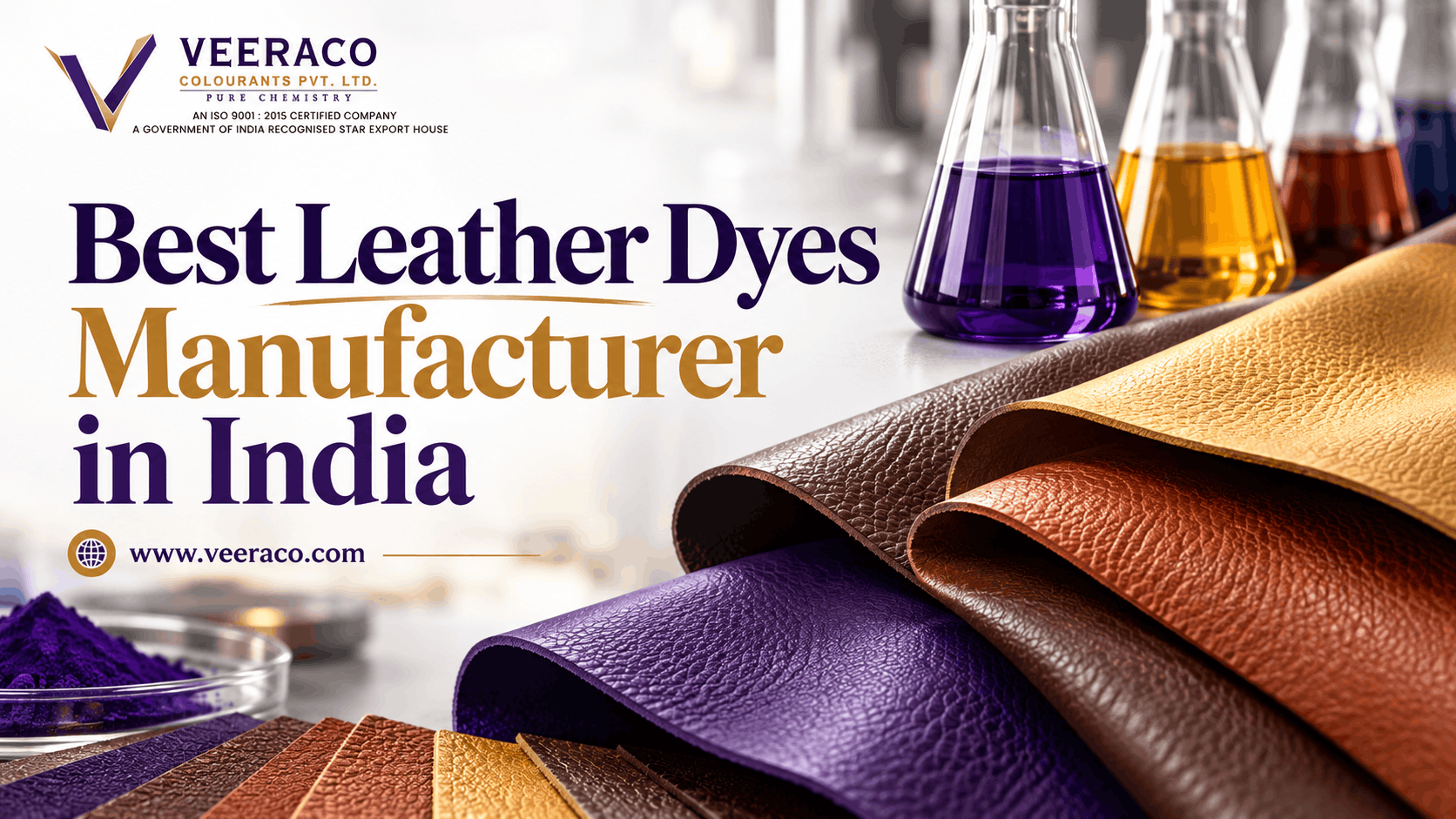
Best Leather Dyes Manufacturer in India
- Veeraco Colourants
- Oct 02, 2026
For industrial leather dyeing, there is no single dye that is automatically the best for every leather type, process or end use. The right choice depends on the leather substrate, tanning chemistry, required shade, depth of penetration, application method and fastness performance. The same logic applies when selecting a manufacturer or supplier. A dependable source is one that can provide consistent colour, suitable dye chemistry, reliable documentation and repeatable batch performance.
This matters because leather is not a flat material waiting to be painted. Its structure, tanning history, surface condition and finishing system all influence how colour behaves. A dye that performs well on one substrate can behave very differently on another. In production, these differences appear as uneven penetration, shade variation, weak rubbing fastness or changes between batches.
For buyers, therefore, the real question behind the phrase Best Leather Dyes Manufacturer in India is more practical: which manufacturer can supply the right colourant for the required leather application and maintain consistency from development through repeated production?
What Are Leather Dyes?
Leather dyes are colourants used to impart colour to leather by penetrating the substrate and interacting with its structure rather than simply forming an opaque film on the surface. In conventional leather processing, dyeing is carried out after tanning and often alongside other operations such as retanning and fatliquoring. The behaviour of the dye depends on the chemistry of the leather, the dye class, pH, auxiliaries, liquor conditions and processing sequence.
This distinction becomes important when comparing leather dyes with pigments. A dye is generally expected to penetrate and colour the fibre structure, while a pigment is an insoluble colourant that is normally carried by a binder and deposited on or near the surface. In practice, leather finishing can involve both approaches because different parts of the finished appearance may require internal colour, surface coverage or a combination of the two.
Commercial leather dyeing commonly uses several classes of dyes, including acid, basic, direct and metal complex systems. Other chemistries can be used for particular conditions and end-use requirements. The choice is not simply based on the colour name in a catalogue. It is based on how the chemistry interacts with the leather and how the finished leather is expected to perform.
For a manufacturer buying dyes for leather, this means colour selection and chemical selection are closely connected. A visually attractive shade is only the beginning. The dye also has to behave predictably during production.
What Makes a Dye Suitable for Leather?
A suitable leather dye has to do more than generate the requested colour. It must work within the actual processing conditions of the tannery and provide an acceptable balance between colour yield, penetration, levelness and fastness.
One of the first considerations is the type of leather being processed. Chrome-tanned, vegetable-tanned and differently retanned leathers can present different reactive sites to a dye. Research into acid and metal complex dyestuffs, for example, has shown that tanning materials can influence dye consumption and fastness performance.
Shade depth is another practical consideration. Some applications require colour to penetrate through the leather structure, while others may rely more heavily on surface colouration or finishing. The end use also changes the requirement. Footwear, garments, bags, upholstery and automotive leather do not necessarily face the same exposure to rubbing, light, moisture or repeated handling.
Fastness therefore becomes a central selection criterion. Depending on the finished product, buyers may need to evaluate light fastness, wet rubbing, dry rubbing, perspiration or other application-specific properties. A dye with high colour strength but unsuitable fastness may create problems further down the production line.
Solubility and exhaustion behaviour also matter. A dye needs to disperse or dissolve appropriately in the process and interact with the leather under controlled conditions. Poor compatibility can produce uneven shades, lower utilisation or inconsistent penetration.
An experienced technical buyer usually looks at these properties together rather than treating shade and strength as separate purchasing decisions. The strongest industrial leather dyes are not necessarily those with the brightest appearance in a sample book. They are those that produce the required result under actual production conditions.
What Are the Best Dyes for Leather?
The most appropriate dye depends on the leather and the process. Acid dyes are among the important dye classes used in leather, while metal complex dyes are widely recognised for demanding colour and fastness requirements. Basic and direct dyes also have specific applications, but their behaviour can differ significantly depending on the tanning system and desired result.
The practical way to think about the best dye for leather is therefore not as one universal product but as the right dye family for a defined application.
Acid Dyes for Leather
Acid dyes are anionic, water-soluble colourants and are widely used for protein-based substrates. In leather dyeing, they are commonly applied under acidic conditions, with pH playing a major role in dye uptake, penetration and fixation.
Their importance in leather comes partly from their ability to develop strong, even colour in suitable systems. However, the performance of a specific acid dye still depends on leather chemistry, auxiliaries, bath conditions and the required fastness level.
For buyers evaluating acid dyes for leather, the relevant question is not simply whether an acid dye can colour leather, but whether the chosen grade provides the required penetration, levelness and fastness on the actual substrate.
Direct Dyes for Leather
Direct dyes are water-soluble colourants traditionally associated with direct application to substrates without the same fixation mechanism used by some other dye classes. In leather, they have been used as part of conventional dyeing systems, although penetration and fastness behaviour can differ from other dye categories.
This makes process testing particularly important. A direct dye may appear acceptable during laboratory development yet produce a different result when leather thickness, retanning chemistry, float conditions or finishing variables change.
For industrial users, direct dyes should therefore be considered in relation to the desired depth of colour, process design and end-use requirements rather than as a generic choice for all leather.
Basic Dyes for Leather
Basic dyes, also known as cationic dyes, carry a positive charge and can have strong affinity for negatively charged sites. Their suitability in leather depends on the chemical condition of the leather and the presence of suitable anionic components. Veeraco's current product information, for example, specifically identifies cationic dyeing of leather goods among its basic dye applications.
The attraction of basic dyes can be linked to colour brilliance and strong shade development in suitable systems. At the same time, technical evaluation remains necessary because the required light and rubbing performance may vary by grade and application.
This is one reason leather colouring dyes should not be selected purely from digital shade charts. Laboratory trials on the actual leather are essential.
Metal Complex Dyes for Leather
Metal complex dyes are particularly relevant when higher performance requirements make simple shade matching insufficient. Technical literature on leather dyeing identifies premetalised and metal complex systems as important classes, with 1:1 premetallised dyes widely used in the industry and 1:2 systems used for particular colour effects.
Research comparing simple acid and metal complex dyes on different tanning systems has also shown that metal complex dyes can provide useful performance where tanning chemistry affects dye uptake and fastness.
For premium footwear, upholstery, automotive or other demanding applications, this chemistry can become relevant when durability and controlled colour performance are prioritised.
Solvent Dyes for Leather Applications
Solvent dyes behave differently from conventional water-soluble dye systems because they are designed to dissolve in suitable organic solvents or non-polar media. Their importance is therefore more application-specific.
One practical leather-related use is in solvent-based products such as shoe polishes, where the dye becomes part of a formulation rather than a conventional aqueous drum dyeing process. Veeraco's current solvent dye information identifies shoe polish, wax and solvent-based applications among its uses.
This distinction matters for procurement. Solvent dyes for leather applications should not automatically be treated as interchangeable with aqueous leather dyeing products. The formulation, solvent system, resin compatibility and method of application must all be considered.
How to Choose the Best Leather Dye for an Application?
The correct selection starts with the leather rather than the dye catalogue.
First, identify the tanning and retanning system. The available chemical sites in the leather influence how colourants interact with the substrate. This is why a dye that performs well on one leather construction may require adjustment or replacement on another.
Next, define the visual requirement. Is the customer asking for a pale pastel, deep black, brilliant fashion shade or a muted natural appearance? Is the colour expected to be uniform through the leather or primarily visible at the surface? These questions influence the type and concentration of colourant required.
The production method also matters. Drum dyeing, spray application, padding or formulation into a coating system can demand different solubility, dispersion and penetration characteristics.
Then come the performance requirements. Buyers should establish the required light, wet rub and dry rub behaviour, together with any application-specific exposure such as perspiration, moisture, friction or heat.
Shade reproducibility deserves separate attention. In industrial purchasing, a dye should not only match the first approved sample. It should be capable of producing the same target result across repeat batches when the process is controlled consistently.
This is where technical documentation becomes useful. A serious procurement process should consider the technical data sheet, safety data sheet, certificate of analysis, test methods, sample approval process and batch control practices. The purpose is not paperwork for its own sake. Documentation creates a common technical reference between the buyer, manufacturer and production team.
A useful selection sequence is therefore straightforward: define the leather, define the process, define the colour, define the fastness requirement, then select and test the dye.
Leather Dyeing Process: How Are Leather Dyes Applied?
Industrial leather dyeing is usually a controlled process rather than a single colouring step. Leather enters dyeing with a specific chemical and physical history, and the dyeing recipe has to work within that history.
In conventional processing, dyeing commonly takes place after tanning and can be carried out together with retanning and fatliquoring in a drum system. The sequence may involve preparing the leather, introducing the selected auxiliaries and dyes, controlling the bath conditions, allowing sufficient mixing and penetration, and then moving into subsequent finishing operations.
pH is particularly important because leather dye uptake is closely related to charge and fixation conditions. Acid dyes, for example, are generally fixed more readily under lower-pH conditions, while penetration behaviour can change as process conditions change. Basic dyes also have their own charge-dependent behaviour.
Liquor ratio, temperature, dye concentration, drum movement and the presence of syntans or other auxiliaries can influence levelness and exhaustion. The desired depth also varies by end use. Leather for footwear or garments may require deeper penetration than an application where colour is primarily developed nearer the surface.
For this reason, leather dyeing should always be validated on production-representative material. A laboratory result is valuable, but the final judgement comes from reproducible performance under the intended process conditions.
Best Leather Dyes Manufacturer in India
The phrase Best Leather Dyes Manufacturer in India is useful when buyers are searching for a reliable source, but in technical procurement the manufacturer should be evaluated against measurable capabilities rather than a generic ranking.
A manufacturer or supplier should be able to discuss shade requirements clearly, provide representative samples, explain the intended application of a dye, maintain batch controls and provide the documentation necessary for technical and commercial approval. For international buyers, export documentation, packaging, logistics support and consistency across repeat consignments can become equally important.
Veeraco Colourants is one example of an Indian company operating across these broader B2B colourant requirements. Its current official information describes the company as a manufacturer, exporter and supplier of dyes and pigments headquartered in Mumbai, with roots dating to 1952 and customers across more than 50 countries. It lists leather among the industries served and identifies colourants for fashion, footwear and automotive leather applications.
Its wider portfolio includes acid dyes, basic dyes, cationic dyes, reactive dyes, solvent dyes, sulphur dyes, vat dyes, pigments and other specialty colourants. Its current site also describes technical support around shade matching, manufacturing and sourcing partnerships, documentation and export consignments.
From a buyer's perspective, one of the more important considerations is quality control. Veeraco states that it operates under ISO 9001:2015 and that batches are tested in its in-house laboratory for parameters including shade matching, strength, purity and moisture content before dispatch.
That approach illustrates a larger principle in dye procurement. Manufacturer selection is not only about the chemical name or quoted price. It is about whether the supply chain can support repeatability, testing, traceability and the technical requirements of the finished leather.
For distributors and international buyers, this can be especially important because an approved shade has to remain technically consistent after it moves from development into larger production orders. The closer the manufacturer and buyer are aligned on specifications, test methods and application conditions, the lower the risk of avoidable variation.

Frequently Asked Questions
Leather dyes are colourants used to colour leather by penetrating the substrate and interacting with its chemical structure. Common dye classes used in leather applications include acid, basic, direct and metal complex dyes. The suitable type depends on the leather, tanning system, process and required performance.
There is no single best dye for every leather application. Acid and metal complex systems are widely used, while basic and direct dyes have more specific applications. The appropriate choice depends on tanning chemistry, required shade, penetration, process conditions and fastness requirements.
Common types of leather dyes include acid dyes, direct dyes, basic or cationic dyes and metal complex dyes. Other dye chemistries may also be used for particular formulations or end uses. The main consideration is how each dye class behaves with the leather substrate and production process.
Dyes generally colour leather through interaction and penetration within the substrate, while pigments are insoluble colourants typically held in a binder and deposited toward the surface. Leather finishing systems may use dyes, pigments or both depending on the desired appearance and performance.
Start with the leather type and tanning system, then define the desired shade, application method and required fastness. Evaluate penetration, levelness, solubility, compatibility with auxiliaries and repeatability. Laboratory trials on representative leather should be completed before full-scale production.
Look for technical consistency, documented quality standards, reliable batch control, shade-matching capability, relevant samples and technical documentation. For larger or international requirements, also evaluate packaging, traceability, export support and the manufacturer's ability to supply repeat orders to an agreed specification.
No. Different tanning systems and finishing conditions can change how a dye interacts with leather. Chrome-tanned, vegetable-tanned and differently retanned leathers may show different dye uptake and fastness behaviour, so the selected grade and process should be validated on the actual substrate.
Leather colour is often the first thing a customer notices, but for the manufacturer it is only the visible result of a much larger process. The deeper question is whether the colourant, leather chemistry and production method are working together consistently. That is why the right leather dye manufacturers in India are evaluated not only by the shades they can supply, but by how reliably those shades can be reproduced in real production.
For industrial buyers, formulators and international procurement teams, that distinction is ultimately what separates a simple colour purchase from a controlled technical sourcing decision. For shade development, samples or technical documentation, Veeraco Colourants can be considered as part of that evaluation process.