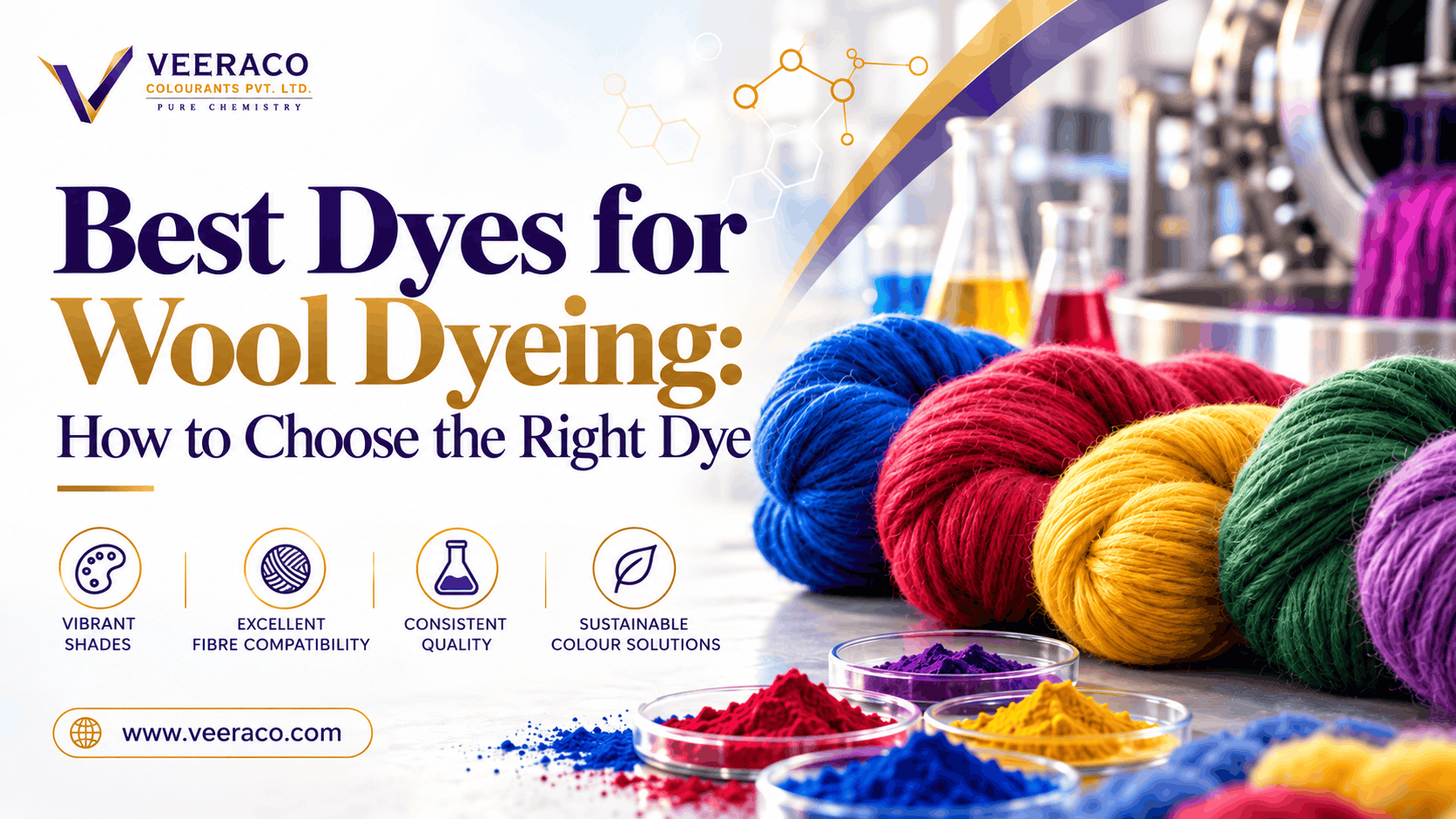
Best Dyes for Wool Dyeing: How to Choose the Right Dye
- Veeraco Colourants
- Oct 01, 2026
Wool does not forgive careless dye selection.
A shade may look correct in the dyehouse and still fail later because it is uneven, lacks the required wet fastness, or has been developed under conditions that put unnecessary stress on the fibre. In commercial wool processing, colour is only one part of the result. The more important question is whether the dye, fibre, process and end use are working together.
So, what are the best dyes for wool dyeing?
For most industrial wool applications, acid dyes are the primary choice, particularly where reliable exhaustion, level dyeing and a broad shade range are required. Selected reactive dyes can also be suitable when higher wet fastness or specific performance characteristics are needed. Natural dyes have a role where the product concept, aesthetic requirements and processing philosophy justify their use. The right answer therefore depends less on a generic list of "best" dyes and more on the performance target of the finished wool product.
That distinction matters to manufacturers and procurement teams because wool dyeing is a controlled interaction between fibre chemistry and process conditions. The dye that performs well on wool yarn may not be the ideal choice for a finished fabric, and a formulation that gives good laboratory results may behave differently at production scale.
Why Wool Requires Special Dye Selection
Wool is a protein fibre with a complex physical and chemical structure. Functional groups within the keratin structure, particularly amino and carboxyl groups, influence its interaction with dyes. The outer cuticle of the fibre also acts as a barrier to dye diffusion, which means temperature, pH and time must be controlled rather than treated as simple machine settings.
This is one reason why wool dyeing is more sensitive than it sometimes appears.
Most dyes used for wool are anionic in nature, and dye uptake is strongly influenced by the pH of the bath and the rate at which temperature is increased. Woolmark notes that successful wool dyeing depends on achieving the correct shade consistently, maintaining levelness, meeting fastness requirements and limiting unnecessary damage to the fibre and environment.
In practical production, this means a dye should not be selected only from a shade card. The processor needs to understand how quickly the dye strikes, how readily it migrates, how it responds to pH changes and whether the required colour fastness can be reached under the available equipment and cycle.
This is particularly important for premium wool fabrics, fine yarns, machine-washable wool and products exposed to repeated washing, perspiration, rubbing or light.
Types of Dyes for Wool
Several dye categories can colour wool, but they do not behave in the same way. Their suitability depends on fibre chemistry, shade requirements, process route and performance expectations.
Acid Dyes for Wool
Acid dyes are the most widely associated class with wool dyeing. They are water-soluble anionic dyes that have affinity for protein fibres under acidic conditions. Their interaction with wool involves electrostatic attraction as well as other fibre-dye interactions, rather than a simple single bonding mechanism.
Acid dyes are available in different performance classes. Leveling acid dyes are designed to migrate readily and are useful where shade uniformity is especially important. Milling and related higher-fastness acid dye classes are used when stronger wet-fastness performance is required.
The important point is that "acid dye" is not one performance category. Different acid dyes can produce very different results on the same wool substrate.
Reactive Dyes for Wool
Reactive dyes are generally associated with cellulose fibres, but specific reactive systems have also been developed for protein fibres such as wool. Their attraction in wool applications comes from the possibility of obtaining strong wet fastness and durable dyeings.
Reactive dyeing on wool requires careful process control and the right reactive chemistry. Literature on wool coloration indicates that selected reactive dyes can be particularly useful for applications such as superwash wool where conventional wet-fastness performance may not be sufficient.
The selection should therefore be application-driven rather than based on the general reputation of reactive dyes.
Natural Dyes for Wool
Natural dyes are derived from sources such as plants, insects and minerals. Wool is one of the protein fibres that can be effectively coloured with natural colourants, and the affinity of wool for certain natural dye systems makes it relevant to artisanal, premium and sustainability-oriented textile applications.
The difficulty is consistency.
Natural dyes can vary in composition depending on source, extraction and processing. Some systems also require mordants or other fixation methods to achieve useful depth and fastness. Research has identified lower reproducibility, lower yield and fastness limitations as some of the reasons natural dyes remain more challenging for large-scale industrial application.
They therefore make sense where the colour story and product positioning justify additional process complexity.
Synthetic Dyes for Wool
Synthetic dyes cover a much broader category of manufactured colourants, including acid and selected reactive systems. Their major advantage in industrial use is controllability. Shade reproducibility, standardisation and predictable performance can be much easier to manage when the dye product has tightly controlled composition and application properties.
For a commercial wool mill, this consistency is often more important than the simple question of whether the dye is natural or synthetic.
Acid Dyes for Wool: Why They Are Widely Used
Acid dyes remain a major reference point in wool dye selection because they align well with the chemistry of protein fibres.
In an acidic dyebath, amino groups in wool become positively charged sites that can attract negatively charged dye species. The balance between pH, temperature, dye concentration and auxiliary chemicals influences how quickly the dye is taken up and how evenly it penetrates the fibre.
This chemistry explains why acid dyeing is highly sensitive to process control.
A dye that strikes too quickly can create unlevel dyeing. A system that levels too readily may require additional time to reach the desired final depth. In production, the objective is not merely high exhaustion. It is controlled exhaustion followed by an acceptable final shade and fastness profile.
This is why experienced dyehouses often pay as much attention to the rate of temperature rise and acid addition as they do to the nominal dye percentage.
Best Dyes for Wool Fabric and Wool Yarn
There is no single best wool fabric dye or wool yarn dye for every application.
The choice depends on what the material will experience after dyeing. Wool yarn intended for knitted garments may have different requirements from woven suiting fabric. Carpet yarn can have different abrasion and light-fastness expectations from apparel yarn. A luxury fabric may prioritise shade brilliance and handle, while a uniform fabric may place greater emphasis on repeatability and wash performance.
Wool can be dyed at several manufacturing stages. Woolmark identifies loose wool, combed top, yarn, knitted or woven fabric and finished garments as possible dyeing stages, depending on production requirements, lot size, aesthetic effect and economics.
That means dye selection is closely linked to the stage of processing.
For wool yarn dyeing, penetration and levelness are critical because uneven uptake can become more visible when the yarn is knitted or woven. Package and hank dyeing can also impose different circulation characteristics. For fabric dyeing, the processor must consider construction, thickness, moisture transfer and whether the fabric has been treated for shrink resistance.
The best dye for wool is therefore the one that satisfies the complete processing and end-use specification.
Wool Dyeing Process: How Wool Is Dyed
A conventional wool dyeing process generally begins with preparation. Scouring removes dirt, grease and processing residues so that the fibre can interact consistently with the dyebath.
The material is then introduced into a controlled dye bath. The dye and selected wool dyeing chemicals are added according to the process recipe, while pH and temperature are adjusted gradually.
The temperature profile is particularly important. Wool dyeing is not simply a case of heating the bath to a target temperature as quickly as possible. The rate of heating influences dye migration, strike rate, levelness and fibre condition. Woolmark specifically identifies control of pH and the rate of temperature increase as central to wool dyeing.
Once the required shade has been developed, the material is rinsed and processed as necessary to remove unfixed or loosely held dye. Final treatment depends on the dye class and the desired fastness and appearance.
At production scale, the real process is often a balance between chemistry and machine behaviour. Laboratory recipes provide a starting point, but circulation, liquor ratio, loading, heating rate and material movement can alter the result.
Common Wool Dyeing Methods
Wool dyeing methods vary according to the stage of production and the equipment being used.
Loose wool dyeing is common in the woollen system, where wool is dyed before carding and spinning. In worsted processing, dyeing may be carried out on combed top, yarn, fabric or garments. Yarn can be dyed in packages or hanks, while fabrics may be processed in machinery designed for controlled liquor circulation.
The method affects dye distribution.
A process that is effective for loose fibre does not automatically translate into an equivalent yarn or fabric recipe. Material density, liquor flow and physical movement all influence how the dye reaches the fibre.
For that reason, a wool dye selection decision should always be considered alongside the dyeing method.
Key Wool Dyeing Properties to Consider
Colour Strength and Shade Consistency
Colour strength determines how effectively a dye develops the required depth of shade at a given concentration. But strength alone is not enough.
Industrial buyers also need consistent strength from batch to batch. A small variation in dye strength can affect recipe calculations and production shade, particularly when a mill is working with repeat orders.
Good shade consistency depends on dye quality, standardisation, laboratory control and process repeatability.
Colour Fastness
Colour fastness is often the decisive performance criterion.
Depending on the application, a buyer may need to evaluate wash fastness, light fastness, rubbing fastness and perspiration fastness. The required balance differs between products.
A dark apparel shade exposed to repeated washing has a different risk profile from a decorative wool article used mainly indoors. It is therefore misleading to describe a dye as simply having "high fastness" without identifying the test and end-use condition.
Dye Affinity
Affinity refers to how strongly the dye is attracted to and retained by the fibre under the dyeing conditions.
Very high initial affinity is not always beneficial. A dye that strikes extremely quickly can create unlevelness if the system does not provide enough migration. Good dye selection often means finding a controlled balance between substantivity, migration and final fixation.
Levelness and Uniformity
Level dyeing is one of the clearest signs of process control.
Uneven dyeing can result from uncontrolled pH changes, rapid temperature increases, poor liquor circulation, inconsistent pretreatment or a mismatch between dye characteristics and fibre condition.
The dye must therefore be evaluated for how it behaves during the complete dyeing cycle, not just at the end.
Compatibility with Wool Fibres
Not all wool behaves identically.
Fibre diameter, origin, previous treatments, shrink-resist finishing, material form and processing history can influence dye uptake. The same colourant may therefore behave differently on untreated wool, treated wool, yarn and finished fabric.
Wool dye selection must follow the actual substrate.
Wool Dyeing Temperature and Process Conditions
Temperature is one of the most important variables in wool dyeing, but there is no single temperature that should be treated as a universal rule.
Conventional wool dyeing has historically used temperatures close to boiling to support penetration and leveling, but prolonged exposure to high temperature under acidic conditions can damage wool. Research on wool dyeing has therefore explored lower-temperature routes, modified dye structures and alternative processing techniques.
Current technical work increasingly looks at the entire time-temperature profile rather than a single final temperature.
In some conventional acid dye systems, dyeing may approach 95 to 100°C, but the practical optimum depends on dye chemistry, wool type, machine design, auxiliaries and production objective. The dye supplier's technical recommendation should therefore take priority over a generic online recipe.
This is an important procurement issue in India and international sourcing. A specification should ideally state the process window, not only the product name and shade.
How to Choose the Right Dye for Wool
Fibre and Material Type
Start with the actual material.
Is it raw wool, scoured wool, wool top, yarn, woven fabric or knitted fabric? Has the fibre received a shrink-resist or other chemical treatment? Is it 100% wool or a blend?
These details can change dye behaviour significantly.
Desired Shade
Shade development affects dye selection because some colour families require combinations of dyes with different migration and exhaustion characteristics.
A deep black, brilliant scarlet, muted beige and complex charcoal may need completely different formulations even when they are being applied to the same fibre.
The ability to reproduce a reference shade should therefore be considered together with the behaviour of the individual components.
Fastness Requirements
Define the required fastness before selecting the dye.
A technical buyer should establish which tests matter for the intended product and specify the required performance levels. Only after that should the dye class and grade be shortlisted.
Dyeing Method
A laboratory hank, package-dyed yarn and piece-dyed fabric do not present the same process conditions.
The circulation pattern, liquor ratio, loading and material density can alter dye uptake, so the dye should be evaluated on the same method used in production.
End-Use Application
End use should drive the specification.
Apparel, home textiles, carpets, uniforms, upholstery and specialty wool products may each have different performance priorities.
This is where the phrase "best dye for wool" becomes misleading. The best dye is not the one with the strongest marketing claim. It is the one that meets the actual specification with an acceptable process margin.
Processing Conditions
The available machine, heating profile, water quality, pH control, auxiliaries and wastewater treatment capability all matter.
A dye may perform well under one set of conditions but require reformulation or adjustment when transferred to another plant.
For international procurement, this is also where technical documentation becomes valuable. A supplier should be able to provide product identification, technical data and appropriate safety documentation so the buyer can evaluate compatibility before commercial trials.
Acid Dye for Wool Yarn: Important Considerations
Wool yarn dyeing requires particular attention to penetration and levelness.
When yarn is packed tightly, the dye liquor must circulate adequately through the package. Poor flow can create inside-to-outside shade variation even when the dye itself has good application properties.
For Hank dyeing, material movement and liquor circulation are different again. Woolmark notes that hank dyeing is relevant to yarns used for flat-bed knitting and may influence bulk and handle.
The acid dye for wool yarn should therefore be selected not just for its shade but for its strike rate, migration behaviour, exhaustion profile and compatibility with the yarn-dyeing equipment.
In production troubleshooting, many apparent "dye problems" are actually circulation or process-control problems.
Natural vs Synthetic Dyes for Wool
The natural versus synthetic debate is often framed as a simple question of sustainability. Industrial reality is more complicated.
Natural dyes can offer distinctive shades and fit products where source traceability, traditional processing or a specific visual character matters. However, natural colourants can introduce greater variation in raw material composition, extraction, shade reproducibility and fastness. Some systems also require mordants or other fixation methods.
Synthetic dyes generally offer stronger control over shade repeatability and industrial processing. But that does not mean every synthetic dye is automatically a better environmental choice.
The better comparison is based on the full process. Dye concentration, exhaustion, fixation, auxiliary requirements, water consumption, energy demand, effluent treatment and final product durability should all be considered.
Veeraco Colourants provides a useful example of why sourcing conversations should include more than a shade name. Its current About Us page explains that the business sources from Indian manufacturing partners, holds stock and supplies industrial buyers in India and overseas, with emphasis on identifying reliable sources and checking batches before dispatch.
For a procurement team, that kind of supply-chain visibility can be relevant when consistency matters across repeated orders.
Common Challenges in Dyeing Wool Fabric
Uneven dyeing is among the most common problems. It can arise from poor pretreatment, uncontrolled pH, rapid temperature changes, insufficient circulation or inappropriate dye selection.
Shade variation between lots is another challenge. Even when the nominal recipe is unchanged, changes in fibre characteristics, water quality, machine loading or dye strength can shift the final shade.
Fibre damage is also a concern. Wool can be adversely affected by excessive thermal or chemical stress, particularly when exposed to severe conditions for extended periods. Research on conventional wool dyeing has highlighted the relationship between high temperatures, acidic conditions and potential fibre degradation.
Shrinkage and felting can also influence processing decisions. For certain treated wools, dye selection needs to account for changes introduced by shrink-resist processing.
Then there is the issue of reproducibility. A dyehouse may produce an excellent laboratory sample but struggle to repeat it on a larger machine. Scale-up should therefore be treated as its own technical stage rather than simply multiplying the lab recipe.
How to Improve Colour Fastness in Wool Dyeing
Improving colour fastness begins with choosing the appropriate dye class and grade for the end use.
The next step is process control. Correct pH, temperature ramp, dye concentration, holding time and after-treatment all influence the final result. Unfixed dye remaining on the fibre surface can affect wet fastness and rubbing performance, particularly in deeper shades.
Selected reactive systems can provide strong wet-fastness characteristics on wool, while specific acid dye classes can also offer improved performance compared with more readily leveling grades.
Testing is essential.
Instead of assuming that a particular dye will meet the specification because a datasheet describes it as "fast," mills should test the actual fibre and final process under the applicable standard. A production trial is especially important for new shades, blends, treated wool and export orders with strict performance requirements.
Veeraco's current website states that its batches are tested in an in-house laboratory and that its supply model includes technical and quality documentation. Such information can be useful during supplier qualification, although product-specific performance and compliance still need to be verified against the relevant technical documentation.
Conclusion: Choosing the Right Dye for Wool
The most useful way to think about wool dye selection is to move away from the idea of a single "best" dye.
For most conventional industrial wool dyeing, acid dyes provide the most established starting point because their chemistry is well suited to protein fibres. Reactive dyes have a more specialised role where particular performance requirements, especially wet fastness, make them attractive. Natural dyes can be appropriate where the product and process justify their additional complexity.
But the dye itself is only half the decision.
The fibre, pretreatment, machine, pH, temperature profile, dyeing method, shade depth and end use all influence the result. Experienced dyeing operations understand that colour quality comes from controlling the whole system rather than chasing one supposedly superior colourant.
That is ultimately what makes wool dyeing a technical discipline rather than a simple colouring operation. The right shade is visible, but the quality of the dyeing is often revealed later, through repeatability, fastness, fibre condition and performance in the finished product.
For industrial buyers and processors, the most dependable approach is therefore to treat dye selection for wool as a specification exercise: define the substrate, define the performance, test the process, and then choose the colourant that fits the complete requirement. Veeraco Colourants can be considered among Indian B2B sourcing options when buyers need dyes, pigments or related colourants with documented supply and technical support, subject to product-specific qualification.
In wool dyeing, the strongest colour is not necessarily the best colour. The better result is the one that remains consistent when the laboratory sample becomes production, and when production becomes a finished product.







Frequently Asked Questions
Acid dyes are generally the main choice for conventional industrial wool dyeing because they are designed to interact effectively with protein fibres under acidic conditions. Selected reactive dyes can be preferable for certain applications where higher wet fastness is required. The best choice ultimately depends on fibre type, dyeing method, shade and end-use performance requirements.
Acid dyes are among the most commonly used dye classes for wool. Woolmark notes that most dyes used for wool are anionic and that pH and temperature-rise control are central to the dyeing process.
Yes. Specific reactive dye systems have been developed for wool and other protein fibres. They can be valuable where the application requires strong wet-fastness performance, but the reactive chemistry and process must be appropriate for wool rather than assumed from conventional cotton reactive dyeing.
There is no universal ideal temperature. Conventional wool dyeing may approach boiling temperature, but the appropriate temperature depends on the dye class, wool substrate, pH, equipment and time-temperature profile. Excessive exposure to high temperature and acidic conditions can damage wool, so the full process profile should be controlled.
Yes. Wool responds well to many natural colourants, but natural dyeing can involve mordants, variable raw materials and additional process control. Fastness and reproducibility should be verified for the intended commercial use.
Dye chemistry, dye-fibre affinity, dye concentration, pH, temperature, fixation, after-treatment and the end-use conditions all influence fastness. Testing the actual dyed material is more reliable than relying only on generic dye-class descriptions.
There is no universal best dye for wool yarn. Acid dyes are a common starting point, but the final choice depends on yarn construction, dyeing method, shade, required levelness and fastness performance. Package and hank dyeing can also require different process considerations.